|
Unconventional Natural Gas Resources |
 |
|
|
| Historically, conventional natural gas
deposits have been the most practical, and easiest, deposits to
mine. However, as technology and geological knowledge advances,
unconventional natural gas deposits are beginning to make up an
increasingly larger percent of the supply picture.
So what exactly is unconventional gas? A precise answer to that question is hard to find. What was unconventional yesterday, may through some technological advance, or ingenious new process, become conventional tomorrow. In the broadest sense, unconventional natural gas is gas that is more difficult, and less economically sound, to extract, usually because the technology to reach it has not been developed fully, or is too expensive. For example, prior to 1978, natural gas that had been discovered buried deep underground in the Anadarko basin was virtually untouched. It simply wasn't economical, or possible, to extract this natural gas. It was unconventional natural gas. However, deregulation of the area (and particularly the passage of the Natural Gas Policy Act, which provided incentives towards searching and extracting unconventional natural gas), spurred investment into deep exploration and development drilling, making much of the deep gas in the basin conventionally extractable. Therefore, what is really considered unconventional natural gas changes over time, and from deposit to deposit. The economics of extraction play a role in determining whether or not a particular deposit may be unconventional, or simply to costly to extract. To learn more about the economics of extraction, click here. Essentially, however, there are six main categories of unconventional natural gas. These are deep gas, tight gas, gas-containing shales, coalbed methane, geopressurized zones, and Arctic and sub-sea hydrates. Deep Natural Gas Deep natural gas is exactly what it sounds like - natural gas that exists in deposits very far underground, beyond 'conventional' drilling depths. This gas is typically 15,000 feet or deeper underground, quite a bit deeper than conventional gas deposits, which are traditionally only a few thousand feet deep, at most. Deep gas has, in recent years, become more conventional. Deep drilling, exploration, and extraction techniques have substantially improved, making drilling for deep gas economical. However, deep gas is still more expensive to produce than conventional natural gas, and as such, economic conditions have to be such that it is profitable for the industry to extract from these sources.
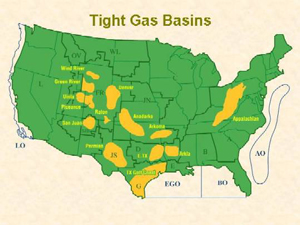
Tight Natural Gas Another form of unconventional natural gas is referred to as tight gas. This is gas that is stuck in a very tight formation underground, trapped in unusually impermeable, hard rock, or in a sandstone or limestone formation that is unusually impermeable and non-porous (tight sand). Here is a graphical depiction, provided by the USGS, of a cross section of a normal reservoir, and a tight gas formation. In a conventional natural gas deposit, once drilled, the gas can usually be extracted quite readily, and easily. A great deal more effort has to be put into extracting gas from a tight formation. Several techniques exist that allow natural gas to be extracted, including fracturing and acidizing. However, these techniques are also very costly. Like all unconventional natural gas, the economic incentive must be there to incite companies to extract this costly gas instead of more easily obtainable, conventional natural gas. Tight gas makes up a significant portion of the nation's natural gas resource base, with the Energy Information Administration (EIA) estimating that, as of January 1, 2000, 253.83 Tcf of technically recoverable deep natural gas exists in the U.S. This represents over 21 percent of the total recoverable natural gas in the United States, and represents an extremely important portion of natural gas resources.
Devonian Shale Gas Natural gas can also exist in Devonian shale deposits. Devonian shales are formed from the mud of shallow seas that existed about 350 million years ago (during the Devonian period of the Paleozoic era). Shale is a very fine-grained sedimentary rock, which is easily breakable into thin, parallel layers. It is a very soft rock, but does not disintegrate when it becomes wet. These shales can contain natural gas, usually when two thick, black shale deposits 'sandwich' a thinner area of shale. Because of some of the properties of these shales, the extraction of natural gas from shale formations is more difficult (and thus expensive!) than extraction of conventional natural gas. Most of the natural gas containing Devonian shale in the U.S. is located around the Appalachian Basin. Although estimates of the amount of natural gas contained in these shales are high, it is expected that only about 10 percent of the gas is recoverable. However, their potential as a natural gas supply is still very promising, given an adequate technological and economic environment. The EIA estimates that there are 55.42 Tcf of technically recoverable shale gas in the United States, representing just under 5 percent of total recoverable resources.
Coalbed Methane Coal, another fossil fuel, is formed underground under similar geologic conditions as natural gas and oil. These coal deposits are commonly found as seams that run underground, and are mined by digging into the seam and removing the coal. Many coal seams also contain natural gas, either within the seam itself or the surrounding rock. This coalbed methane is trapped underground, and is generally not released into the atmosphere until coal mining activities unleash it. Historically, coalbed methane has been considered a nuisance in the coal mining industry. Once a mine is built, and coal is extracted, the methane contained in the seam usually leaks out into the coal mine itself. This poses a safety threat, as too high a concentration of methane in the well create dangerous conditions for coal miners. In the past, the methane that accumulated in a coal mine was intentionally vented into the atmosphere. Today, however, coalbed methane has become a popular unconventional form of natural gas. This methane can be extracted and injected into natural gas pipelines for resale, used as an industrial feedstock, or used for heating and electricity generation. The EIA estimates that 60.35 Tcf of technically recoverable coalbed methane exists in the United States, making up over 5 percent of the total natural gas resource base. What was once a by-product of the coal industry is becoming an increasingly important source of methane and natural gas. For more information on coalbed methane, visit the Environmental Protection Agency. Geopressurized Zones Geopressurized zones are natural underground formations that are under unusually high pressure for their depth. These areas are formed by layers of clay that are deposited and compacted very quickly on top of more porous, absorbent material such as sand or silt. Water and natural gas that is present in this clay is squeezed out by the rapid compression of the clay, and enters the more porous sand or silt deposits. This natural gas, due to the compression of the clay, is deposited in this sand or silt under very high pressure (hence the term 'geopressure'). In addition to having these properties, geopressurized zones are typically located at great depths, usually 10,000-25,000 feet below the surface of the earth. The combination of all of these factors makes the extraction of natural gas in geopressurized zones quite complicated. However, of all of the unconventional sources of natural gas, geopressurized zones are estimated to hold the greatest amount of gas. Most of the geopressurized natural gas in the U.S. is located in the Gulf Coast region. The amount of natural gas in these geopressurized zones is uncertain. However, experts estimate that anywhere from 5,000 to 49,000 Tcf of natural gas may exist in these areas! Given the current technically recoverable resources are around 1,100 Tcf, geopressurized zones offer an incredible opportunity for increasing the nation's natural gas supply. Methane Hydrates Methane hydrates are the most recent form of unconventional natural gas to be discovered and researched. These interesting formations are made up of a lattice of frozen water, which forms a sort of 'cage' around molecules of methane. These hydrates look like melting snow and were first discovered in permafrost regions of the Arctic. However, research into methane hydrates has revealed that they may be much more plentiful than first expected. Estimates range anywhere from 7,000 Tcf to over 73,000 Tcf! In fact, the USGS estimates that methane hydrates may contain more organic carbon than the world's coal, oil, and conventional natural gas - combined! However, research into methane hydrates is still in its infancy. It is not known what kind of effects the extraction of methane hydrates may have on the natural carbon cycle. For more information about the exciting frontier of methane hydrates, click here.
|