I recently attended the ASPO-USA annual conference in Washington, DC. Overall, I found the presentations and discussion to be very engaging. The vibe this year had much less of a doomsday feel than last year and the topic of how best to tell an engaging Peak Oil story came up often. In the notes below I attempt to recap the sessions I attended with the caveat that these notes reflect primarily what I paid attention to. No attempt is made to be complete or unbiased in my coverage of the conference. I apologize in advance for any omissions or misrepresentations. In the next few weeks ASPO should make videos of the presentations available on aspo.tv.
2011 ASPO-USA Conference: Day 1
Posted by Jonathan
Callahan on November 9, 2011 - 11:00am
Welcome
I arrived at the conference site a few minutes early to find out that our first session was to take place four blocks away in the Congressional Auditorium underneath the Capitol. After opening remarks, ASPO co-founder and president Jim Baldauf spoke to the need for "Truth in Energy" in taxpayer funded agencies like the EIA and DOE and how these agencies should be more responsive to ASPO concerns about the forecasts they produce.
Next on the agenda were speeches by representatives Mike Honda and Roscoe Bartlett. Honorable Bartlett especially impressed me as an excellent speaker of undaunted courage and completely in command of the facts. No doubt this has to do with his previous career as a scientist and engineer in NASA and the military. By his own reckoning, Bartlett has given 52 hour long speeches on Peak Oil in the House of Representatives. I'm not sure what strings ASPO director Jan Mueller had to pull to get permission to use the Congressional Auditorium but it was an excellent beginning to the conference.
Peak Oil Update: Timing, Trends, Consequences
Chris Skrebowski focused on the importance of emerging markets in any attempt to assess future prices and availability for oil. He pointed out that the bulk of recent growth in supply is actually coming from "other liquids" such as NGL and ethanol. He estimates that current spare capacity is about one million barrels per day. Of greatest concern was his statement that oil companies are now investing in projects that require a per barrel price that will "break the economy" (>$100/bbl). He suggested that this is because the growth in demand is expected in non-OECD countries where the economic utility of oil is much higher than in countries like the United States and that non-OECD economies will be able to bear these high prices. (More of Chris' insight on this topic can be found here.)
Next up was William Catton. His beautiful voice and old-school professorial style were a delight to listen to even if his presentation was a very general one for the technical people in the audience. He spoke of our ever increasing use of energy and the evolution from homo sapiens to what he terms HOMO COLOSSUS. His most concrete suggestion was that economic stimulus today will not have the same affect as in 1938 because he believes we have by now extracted most of the energy resources of our nation. He anticipates a future with rising death rates and resource wars.
Jeff Rubin, as great an entertainer as communicator, spoke without slides and made several points crystal clear. Having an economist that can speak clearly without the typical economic mumbo jumbo and is not afraid to point out economic stupidity where he sees it reminded me at times of the writings of John Kenneth Galbraith. Here are the bullets I jotted down:
- Oil prices affect economies.
- The US congress is guided by economists.
- Economists' basic assumption is: potential growth = productivity growth + population growth.
- Basic assumption of potential growth of 3% is completely disconnected from natural resource limitations.
- Any growth below potential growth means you can "step on the gas" with stimulus.
- China is buying T bonds to keep Chinese inflation down in China.
- Chinese inflation is driven by food and energy prices denominated in dollars.
- Our economy can no longer grow at the rates expected because we are in an expensive oil environment.
- Any efforts to stimulate growth toward 3% will fail and be counterproductive.
- America will eventually default on its debt -- currency depreciation is a form of default
Jeff also explained how Greece's defaulting would likely lead to Portugal, Spain, Italy, and Ireland defaulting. Greece's largest industry is tourism. So is Portugal's. If Greece defaults, and goes back to the Drachma, it will suddenly be a very cheap vacation spot. Portugal will need to default to match, and so on. Rubin also talked about the fact that including the PIIGS in the Euro keeps the Euro lower than it otherwise would be. If the PIIGS leave, then the currency for the remaining countries will rise, leaving the remaining countries with a problem selling their goods. Germany is the #2 exporter after China. So Europe has a huge problem.
Adapting to the End of Cheap Energy: Critical Factors
Richard Heinberg addressed the need to reform the discipline of economics and the belief in infinite growth. Any reasonable version of economics should reflect natural limits and the impact of industrial processes. Richard also talked about the fact that inequality can only be tolerated if the national pie is growing. Now that it isn't, we have a problem. He believes we cannot develop alternative energies fast enough, so we have to expect a less mobile society going forward.
Chris Martenson spoke of our need for national energy priorities and asked: "What is the solution space?" He emphasized the importance of "stories" and noted that our national budget has almost nothing for renewables. Clearly, energy is not part of our national story. He believes we might be able to craft a new national narrative around "Energy stewardship is what we value."
One thing I appreciate tremendously about Chris is that he understands the importance of "framing" and "storytelling" in getting a message across. He has a scientific approach toward getting his message across and has learned through trial and error (and observation and measurement) the importance of crafting different stories, each appropriate for a specific audience.
Angelina Galiteva was a newcomer to the conference. She currently serves on the Board of Governors for the California Independent System Operator and is CEO of NEOptions, a provider of turnkey solar PV solutions. Like the solar people I met at Opal Financial's Clean & Green Forum, Angelina was very optimistic about the promise of solar. She believes that technology will allow us to retain most/all of the trappings of a modern society with 100% renewables in a generation or two. In the United States she sees major policy obstructions to the adoption of solar PV. She was involved in the creation of Germany's Feed-in-Tariff and says the key features of that successful program are the TLC's: Transparency, Longevity, Certainty and Consistency. A PV installation in California requires a large amount of paperwork from different governing bodies depending on location whereas Germany has a simple 2-page document across the entire country. She pointed out that German job growth in the solar and wind sector is significantly higher than in other sectors and that Germany has installed twice as much solar PV as the US with a little more than a quarter of US population.
Angelina's take-home message was that people should stop complaining about the problem and should start taking action on anything that will be part of the solution. She sees solar as a big part of that solution and is doing her utmost to promote it. It's hard to argue with that attitude though there was plenty of skepticism at the conference along with complaints that solar advocates take little account of the fossil fuels embedded in their production.
Roger Bezdek was the final speaker and called our attention to the lack of any meaningful national plan for an oil emergency. His concern is that any decline in oil production will lead to an oil shock and there will be huge public demand to "Do something!" He expects that rationing will be the most politically acceptable outcome as we have don that before. Most of his presentation concerned the complexity and details of implementing a rationing plan. Take home message -- it's complex.
China and the Middle East: Implications for U.S. Energy Security
Michael Klare was snowbound and unable to attend and was replaced by Kjell Aleklett as first speaker. Kjell discussed the importance of giant fields. By his reckoning, 1% of global oil fields currently produce 65% of crude oil. New discoveries are less frequent than in previous decades and a diminishing list of export countries includes many that we may not consider allies. Here is the current list of exporters ranked by 2010 EIA oil export volumes:
1. Saudi Arabia, 2. Russia, 3. Iran, 4. United Arab Emirates, 5. Nigeria, 6. Kuwait, 7. Norway, 8. Angola, 9. Algeria, 10. Iraq, 11. Venezuela, 12. Libya, 13. Kazakhstan, 14. Qatar, 15. Canada, 16. Azerbaijan, 17. Mexico, 18. Oman, 19. Columbia, 20. Sudan , ...
The list alone should give one pause. Except for Norway, Canada and perhaps Mexico, these are not paragons of enlightened, democratic society. Kjell expects Norway to cease exporting in 2035 due to depletion. The Saudi recovery factor is currently 56% and he expects production of near 12 mbd until 2028. But pressurizing fields will require a very high price. He believes that Asia will outcompete the West for available exports and that Russia will not be able to export as much as the EIA expects. Already, exports to (imports by) OECD nations have declined by 5 mbd and he anticipates another 10 mbd decline over the next 10 years because of increasing internal consumption in the oil producing nations.
This was a natural segue to the next speaker, Jeffrey Brown. Jeffrey presented his Export Land Model and the case for paying attention to Peak Exports rather than Peak Production if you live in an importing nation. I agree completely with his emphasis on net export decline as being hugely important to oil security in OECD nations. Because I know the ELM story so well, I took few notes.
Lastly, Minqi Li presented his analysis of China's use of coal. He mentioned using data from China's "coal reserve base" as the best open, regularly updated Chinese government number regarding coal. Minqi noted that China produced 3.2 billion tons of coal in 2010 of which 780 million tons came from Inner Mongolia. In the first eight months of 2011 production has reached 2.5 billion tons of which Inner Mongolia alone has contributed 625 million tons. He expects China to reach a national production of 3.6 billion tons this year including more than 1 billion tons from Inner Mongolia. He sees continued growth in coal production/consumption until 2030. (This was disputed by Kjell.) Minqi sees coal as China's primary energy source until China reaches "peak energy" around 2035. [Corrected to reflect Minqi Li's input.]
The End of Growth
Richard Heinberg spoke quite literally about "the end of growth". Point by point, he argued:
- Cheap energy led to mass production which led to advertising and credit.
- Payment of debt requires future growth.
- Increasing debt for consumers is increasing wealth for banks leading to increased power for financials.
- We are living at the end of history's greatest credit bubble.
- Our economic future will have persistent high unemployment, declining income and net worth, financial instability.
- We need to build local resilience, but it is at odds with economic efficiency.
- Rapid economic growth is an artifact of the fossil fuel age.
- We can have a better quality of life with reduced consumption.
I basically agree with this thesis and give a hearty "Amen!" to 8. But I also believe that the world is, as it always has been, a very heterogeneous place and that some communities are already well on their way toward local resilience. Oil shocks will arrive but will not affect all nations or all regions and towns equally
William Catton spoke again in his lovely stentorian voice and reminisced a little about his happy childhood during the Depression. His main message is that our finite world is ... well ... finite and that non-renewable resources are ... umm ... non-renewable. One clever insight he left us with is the idea that our species has progressed over millennia from foragers to farmers in our quest to provide our bodies with fuel. The current mad dash in search of fossil fuels in Earth's nooks and crannies means that we have completed the circle and returned once again to our forager past. Nice imagery.
Jean Laherère was last to speak and described the widespread confusion in the definition of simple concepts such as units, heat content, density, etc. There is little consistency and there are few rules or standards among companies and nations about how to report. As usual, Jean showed lots of busy charts but his take-home message was this: It is difficult to create a clear message when the wording, units and components of "oil" are in constant flux. (With all due respect to Jean's important analytical work over the years, I would like to suggest that it is also difficult to create a clear message with dozens and dozens of overly crowded charts. Synthesis is sometimes more important than detail when explaining.)
The Shale Gas Rush: Boom or Bust?
Art Berman moderated a panel on shale gas that addressed the (negative) environmental impact of shale gas drilling in western Pennsylvania. I learned a tremendous amount from this late evening session but was disappointed that no one from the industry side was present despite Art's best efforts to find someone. (The lack of the industry perspective was made more poignant by the fact that I had gone out to dinner with an employee of Chesapeake Energy just before this session. One of the advantages of this conference is direct access to people from all sides of the energy issue.) Despite my strong environmental leanings, I would have enjoyed having a technically oriented shale gas proponent as part of the panel.
The first speaker of the evening was Cornell Engineering Professor Anthony Ingraffea who gave a spectacular 20 minute primer on fracking, more properly called High Volume SlickWater Fracturing with Long Laterals (HVSWFLL). Here are the Cliff Notes:
- shale plays are typically ~100' thick
- 4 components in the modern method:
- horizontal wells,
- high volumes of slickwater frac fluids
- multi-stage fracking
- use of multi-well pads
- while each of these techniques is old, the combination is new
- horizontal wells are long
- slickwater has hydrocarbon lubricants to reduce viscosity
- A 16-well pad uses : 417 million gals of water, 78 k tons of sand, 8 million gals of frac chemicals, 500 frac intervals, 10k foot laterals, 40k hp for fracking pumps
- fracking is spatially intense --> lots of pads
- main concerns:
- spatially and temporally intense, heavy industry
- potential migration of hydrocarbons (methane escapes outside of 5% of wells)
- methane is a potent greenhouse gas
- he is VERY much against HVSWFLL
Next up was Bob Howarth, a Cornell ecologist. He described how an estimated 1.9% of total methane production from a well can be inadvertently released during the 2 week frac fluid blowback period as the well is prepared for production. He asserted that shale gas drilling has significantly more methane leakage than conventional gas drilling methods and that, because of this, shale gas actually contributes more to GHG warming than coal or diesel.
Rob Jackson runs a water chemistry lab at Duke University. Being careful not to declare causation, he showed a graph with a very strong correlation between water well distance from a shale gas drill site and the amount of methane detected in water samples. His lab has not, however, detected frac fluids in any water wells. He said it looks like methane leaks up through bad casing jobs rather than geological fractures and believes that better regulation, better construction and better enforcement can help a lot. New regulations in Pennsylvania will include 'presumptive liability' for any water well contamination that is observed within 2500' feet of a drill site as opposed to 1000' feet earlier. He believes this kind of regulation is actually a win for both the public and for industry as it clearly delineates where liability ends.
The session finished with Amy Mall, policy analyst from the NRDC, generally describing the negative environment impacts that are possible with shale gas drilling. Her position was that improved regulation and enforcement can resolve many of the trouble areas associated with shale gas production.
Dinner Conversation: Energy concerns in Austria
At the speakers' dinner (which actually took place on Friday) I enjoyed a conversation with Georg Günsberg of ASPO Austria. Having been an exchange student in Vienna, I was curious about the level of awareness and concern in Austria. He said that there was a teachable moment in 2008 during the Russia-Ukraine gas spat when many thousands of central Europeans in nations like Slovakia were left without heat in the dead of winter. Luckily for Austria, they have 4-6 months of natural gas in storage and they came through without any major shortages. According to Georg, concern about energy is not particularly high at the moment. Austria has long had efficiency built into their building codes and they are now putting up entire apartment blocks that meet Passivhaus standards. Austria is a small country with dense urban cores, an excellent rail system and already high gasoline prices. Austrians (sample size n=1) seem little concerned about reduced mobility in the face of more expensive liquid fuels.
Take Home Messages
If I had to choose the most valuable points I took away from day 1 I would probably include:
- The idea that oil has a much higher utility in developing nations than it does in OECD nations and that this will allow them to drive the price well above $100/bbl.
- Solar advocates enthusiasm is undaunted as solar PV continues to show price declines and increasing adoption rates.
- The current list of top oil exporters is scary.
- Pennsylvania needs to do a better job of regulating the shale gas industry
Keep an eye out for a recap of Day 2.
(Many thanks to Gail, Brian, Rembrandt, Chris and Art for valuable comments and suggestions on an earlier draft.)
COMMENT:
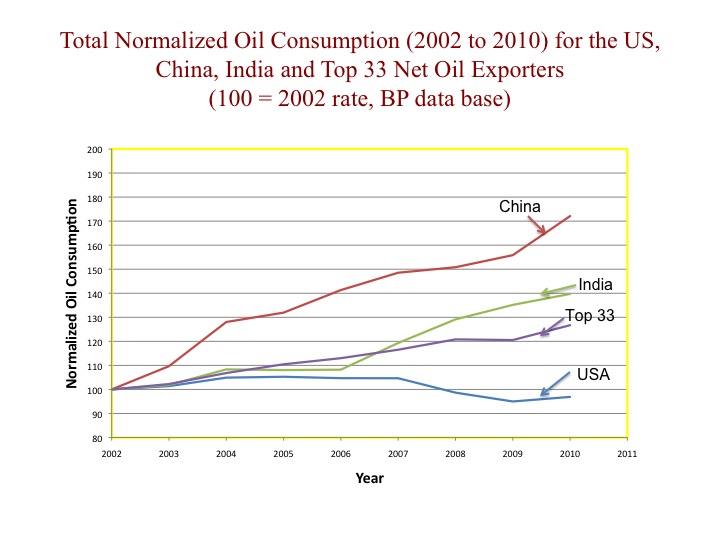
Obviously subsidies are a factor, especially the more extreme examples, e.g. Saudi Arabia & Venezuela, but the consumption trends are pretty obvious too. Note that year over year annual oil prices rose for seven of the eight years from 2002 to 2010, with all post-2005 annual oil prices exceeding the $57 level that we saw in 2005. The key question is what happens going forward.
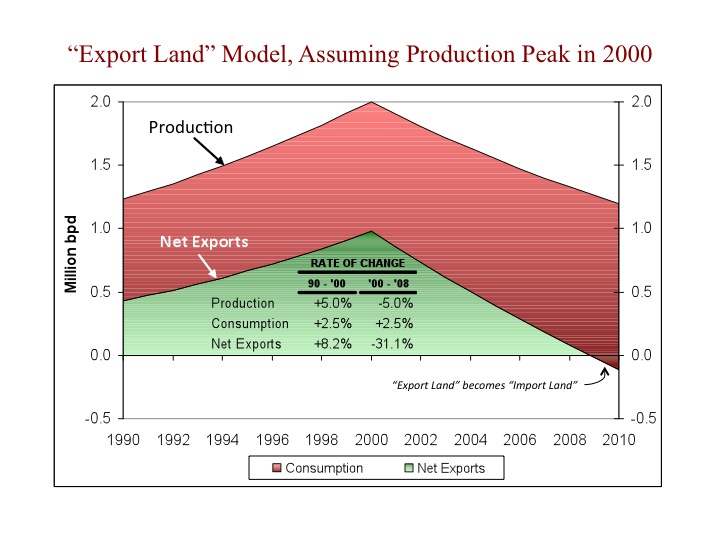
We added something new this year, "ELM, the Prequel." The following chart assumes that "Export Land" peaked in 2000, with production increasing at 5%/year from 1990 to 2000, then falling at 5%/year from 2000 to 2010 (similar to the North Sea). Consumption (in red) rose at 2.5%/year from 1990 to 2010. We are focused of course on Net Exports, shown in green. Note that on the upslope of production, unless the rate of increase in consumption exceeds the rate of increase in production, the rate of increase in net exports will exceed the rate of increase in production. But on the downslope of production, unless consumption falls at the same rate as the rate of decline in production (or at a faster rate), the net export decline rate will exceed the rate of decline in production, and the net export decline rate will accelerate with time:
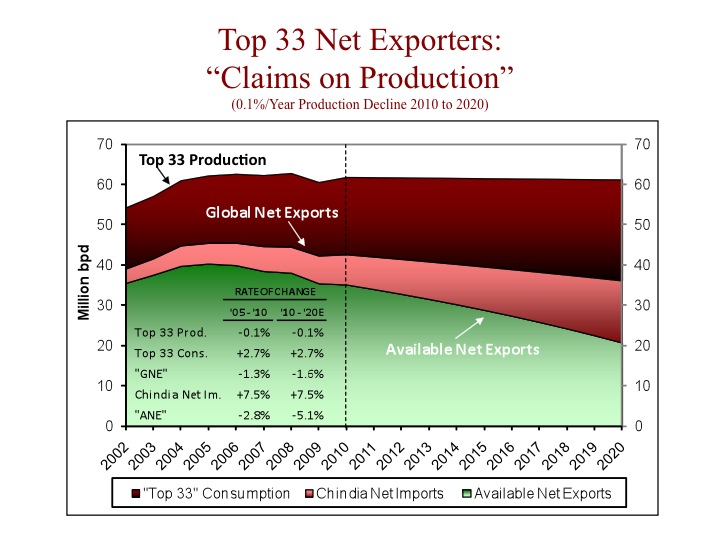
As expected, our data base shows that the rate of increase in Top 33 net oil exports (5.1%/year) exceeded the rate of increase in production (4.6%/year) from 2002 to 2005. But from 2005 to 2010, the rate of decline in net oil exports (1.3%/year) exceeded the (very slight) rate of decline in production (0.1%/year). Note that net exports went from +5.1%/year from 2002 to 2005 to -1.3%/year from 2005 to 2010.
The following chart shows "Claims on Production" by the Top 33 net oil exporters in 2005 (BP + Minor EIA data). If we extrapolate the 2005 to 2010 rates of change in Top 33 production, Top 33 consumption and Chindia's net oil imports, then Available Net Exports (ANE, i.e., Global Net Exports not consumed by China & India) would fall from about 40 mbpd in 2005 to about 21 mbpd in 2020. Based on these extrapolations, a negligible production decline from 2005 to 2020 would result in approximately a 50% decline in the volume of oil available to importers other than China & India.
If we assume a 1.0.%/year production decline rate from 2010 to 2020, ANE fall to about 15 mbpd in 2020.
Note that US net oil imports increased at 11%/year from 1948 to 1970, when we peaked. From 1970 to 1977, US net oil imports increased at 15%/year (EIA). In 1978, net imports declined as Alaskan production kicked in and as consumption started to slump.
If Chinese domestic production falls, their net imports could continue to increase at a rapid clip, even if the rate of increase in their oil consumption slows.
***
It stuck me that this is the important piece as well. If other countries can afford to pay >$100.00 then there will be a constant economic and social reshuffling at least here in the US. Leaving aside what can we do as some members of our society do not have the financial means to implement efficiency and perhaps our government can be added to that list :(. My questioning lies in what will happen or is likely to happen. Perhaps this was answered with the high unemployment, declining lifestyles, and declining net worth comments above. I have always questioned whether leaders actually 'lead' or are they more allowed and/or tolerated. My point being Carter knew about energy (put on a sweater) but the people didn't like or want it 'wala' here we are, fighting wars over oil and looking over the edge.
It will be 'why didn't you tell us?'. That is your first hurdle in talking this up. I suspect if you say - 'You didn't listen or you were not ready to listen' - you will get stone flat denial. It could also be accurate but also worse you were lied to by greedy XYZ's. The unfocused social unrest has already started. My fear is when the pinch gets tight enough someone is going to promise some unsound or unwise pie in the sky. I feel like I have become a spectator in some bad movie.
***
I am very much looking forward to the videos of the presentations. A couple of weeks is rather a long time to wait. Hopefully they'll post it soon.
I first became Peak Oil aware after reading a paper in a Mech. Engineering course in 2002. I remember having lengthy conversations even back then about what alternative energy sources man might adopt. There was a special energy research unit in my university, and one of the fellows in the department kept bringing us round to the nature of the energy trap, and he sensitized our minds.
Since then, the matter has been on my mind for most days. After years of reading, documentaries, following sites like this, I have come to a conclusion which few people who understand the problem would reach:
It appears to me that Man NEEDS his problems. He always needs to be on the edge of a cliff without a bridge before him. Only then will he will have the strong spur he needs to develop and extend his powers further. It is rather too premature, pessimistic, and perhaps absurd, to think that when the entire human race has its back to the wall and is facing worldwide demobilization, starvation and dieoff, that it will simply accept what seems like its inevitable fate. A few of us know what we are up against. A few have seen Goliath, and for years have steadfastly held the belief that David would be no match for him. But David has not even arrived on the battlefield. He has yet not shown his mettle. We do not even know David....yet.
What if all of us turn out to be monumentally wrong? What if the energy crisis is overcome and we end up having even more energy than ever before? All those years of worry would have been for nothing because we were so hopelessly blind to the infinite potentialities of man. Of course, it's much better to worry about a problem when no solution has as yet become visible to our minds. But should that mean that no solution will EVER become visible to billions of minds? Not just billions of mediocre minds, but billions of minds who have greatly extended the intellectual domain with the internet. Ray Kurzweil is right. The greatest force in this world is Intelligence. We may be temporarily deprived of our cheap and abundant energy, but does one any presume to think that with such vast intelligence and awareness within our reach, we will remain impoverished and hopeless for long? If anything, this new special period which we are about to enter will see a tremendous expansion of human intelligence like never before.
I do not know how the next 3 or so decades will pan out. But I do have a gut feeling about something: In 100-200 years man WILL have UNLIMITED energy. I find it difficult to believe that after so many generations of material poverty and suffering, man will still be unable extended his intelligence vastly further and finally understand energy well enough to create unlimited amounts of it himself, without relying on a thoroughly depleted nature. Nothing develops intelligence as rapidly as being confronted with ever present danger. It's quite possible that human reasoning began during the last ice age, when men were confronted with a whole new danger and were compelled to use the mind to come up with new responses to drastically changed circumstance. All of history has been a fight against the limitations of the body, of nature, of time, of space and of mind. We have partly overcome the limitations of time and space with mass communication and transport. We have overcome quite a few of the limitations of nature. We have overcome many of the limitations of the body, like disease, ailments and low life expectancy. We have certainly overcome many of the limitations of consciousness with the creation of an artificial intellectual realm. All of modern history has seen been a gradual expansion of our freedom. It is this which is the foremost desire in the soul of man: the desire for infinite freedom. So I find it just too difficult to believe that man will sink back into slavery to nature, to hunger and want, when he is getting closer and closer to perfect freedom. And the appetite for freedom grows with each new freedom added.
So I'm betting that eventually, the energy crisis will be overcome with the advent of a new form of energy which is infinite. To think anything less would be to grossly underestimate man's desire for infinity in all things.
Creative
Commons License
To subscribe or visit go to:
http://www.platts.com
