Airport Scanner Cancer Risk 'Glossed Over,' Says New Report
Wednesday, November 9, 2011 5:26 PM
By Sylvia Booth Hubbard
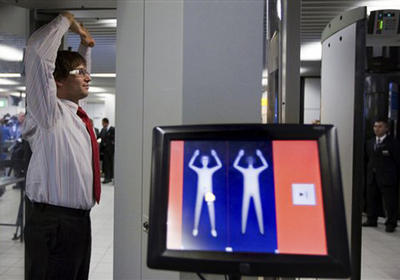 |
The U.S. government whitewashed health risks when they put controversial full-body X-ray scanners in airports throughout the country, says a new report. Airport scanners emit radiation that could be responsible for up to 100 cancer deaths of airline passengers each year, according to the report by ProPublica and the PBS NewsHour.
Questions of safety have dogged the X-ray scanners since they were introduced to American airports two years ago. In Boston, representatives of the Transportation Security Administration (TSA) union believe the scanners could be responsible for a cluster of cancers among airport security workers, according to Time. And experts believe they raise the risk of cancer for ordinary flyers — not just security workers.
When a panel of radiation specialists met in 1998 to assess the new device that could detect hidden weapons by seeing underneath clothing, experts pointed out that its use defied a traditional rule in radiation safety — people shouldn't be X-rayed unless it was for a medical reason. Even the inventor of the scanner, Steven W. Smith, didn't believe they would be used in airports.
Yet the TSA has glossed over the concerns of both scientists and citizens that even low doses of radiation, such as that emitted by the scanners, increase the risk of cancer. Now 13 years later, about 250 of the scanners are in American airports and their numbers are increasing.
The TSA has addressed the concerns of Americans that the scanners were too revealing, and has adjusted the machines to make the images they produce less graphic. But little has been done to address the cancer concerns, even though body scanners (millimeter-wave scanners) — that even the TSA says are just as effective, but use safer low-energy radio waves — are available.
Many experts also question whether or not the TSA should have been the agency to approve their use: Other machines that produce radiation are approved by the Food and Drug Administration (FDA), but since they aren't medical devices, the FDA was skirted. The airport X-ray machines were approved by the TSA, bypassing what many see as the logical agency to check for safety concerns.
The United States plans to add even more scanners to airports in the next two years, despite the fact that many European countries have reached the conclusion that the radiation they produce poses an unacceptable health risk.
Skin cancer is a particular concern to some scientists who warn that the radiation emitted from full-body airport scanners has been seriously underestimated. Last year, four faculty members at the University of California told President Obama's Science and Technology czar, Dr. John P. Holdren, that they were concerned the scanners could cause skin cancer and mutations.
Dr. David Brenner, head of Columbia University's center for radiological research, also expressed concern, saying the dose of radiation absorbed by the skin may be up to 20 times higher than previously thought, and could lead to an increase in skin cancer.
Brenner told the Daily Mail that some groups, such as children and adults with gene mutations, are more sensitive to radiation. "The population risk has the potential to be significant," he said.
TSA agents are also expressing their concern over radiation levels. "We have heard from members that sometimes the technicians tell them that the machines are emitting more radiation than is allowed," Milly Rodriguez, health and safety specialist for the American Federation of Government Employees, which represents TSA officers, was quoted as saying at NJTODAY.NET.
Still, the TSA and other agencies say the scans are safe. According to the Civil Aviation Authority, radiation from a scan is the same as that received during two minutes of a transatlantic flight, and it would take 5,000 scans to equal the radiation dose from a single X-ray.
© Newsmax. All rights reserved. To subscribe or visit go to: http://www.newsmax.com