Bangladesh, India Top Climate Change Vulnerability Index
BATH, UK, October 28, 2011 (ENS) - Some of the world's largest and fastest-growing economies, especially those in South Asia, are most at risk from climate change, finds a new global ranking that calculates the vulnerability of 170 countries to the impacts of climate change over the next 30 years.
The 2011 Climate Change Vulnerability Index, released by global risks advisory firm Maplecroft, evaluates 42 social, economic and environmental factors to assess national vulnerabilities across three core areas.
The index is mapped in Maplecroft's Climate Change Risk Atlas 2011, which evaluates the risks to business relating to emissions, unsustainable energy use, regulation and climate change vulnerability.
The countries at the greatest risk are characterized by high levels of poverty, dense populations, and exposure to climate-related events, as well as their reliance on flood-prone and drought-prone agricultural land.
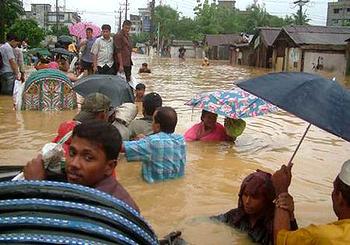 |
Bangladesh residents struggle to cope with floodwaters, October 21, 2011 (Photo by trucbk99) |
Bangladesh tops the list of countries at extreme risk, and India is close behind in second place. Madagascar is third, Nepal fourth, Mozambique is in fifth place and the Philippines comes sixth.
Haiti, Afghanistan, Zimbabwe and Myanmar (Burma), in that order, round out the top 10 countries listed as at extreme risk. Vietnam and Pakistan are also listed in the extreme risk category, although not in the top 10.
"These countries are attracting high levels of foreign investment from many multinational organizations," said Dr. Matthew Bunce, principal environmental analyst at Maplecroft.
"However, over the next 30 years their vulnerability to climate change will rise due to increases in air temperature, precipitation and humidity," he said.
"This means organizations with operations or assets in these countries will become more exposed to associated risks, such as climate-related natural disasters, resource security and conflict," said Dr. Bunce.
Risk factors include exposure to climate-related natural disasters and sea level rise.
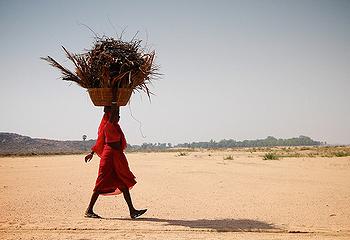 |
Woman carries firewood across a dry riverbed in Bodhgaya, India, the site of Buddha's enlightment. May 7, 2010. (Photo by JC Indie) |
Risks such as human sensitivity in terms of population patterns, development, natural resources, agricultural dependency and conflicts are also factored into the assessment.
Future vulnerability was determined according to the adaptive capacity of a country's government and infrastructure to withstand climate change.
"Understanding climate vulnerability will help companies make their investments more resilient to unexpected change," said Dr. Bunce.
Throughout 2010, changes in weather patterns have resulted in a series of devastating natural disasters, especially in South Asia, where heavy floods in Pakistan killed more than 1,700 people and affected more than 20 million, over 10 percent of the population.
"There is growing evidence climate change is increasing the intensity and frequency of climatic events," said Dr. Anna Moss, an environmental analyst at Maplecroft.
"Very minor changes to temperature can have major impacts on the human environment, including changes to water availability and crop productivity, the loss of land due to sea level rise and the spread of disease," she said.
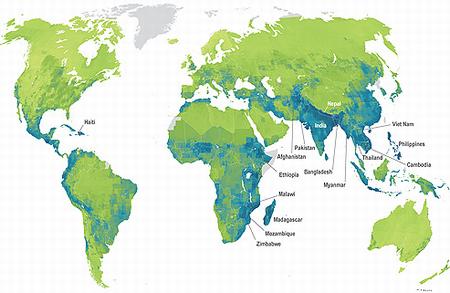 |
In this Maplecroft map of climate change vulnerability, the darker the color, the higher the risk. (Map courtesy Maplecroft) |
Maplecroft rates Bangladesh as the country at greatest risk due to extreme levels of poverty and a high dependency on agriculture, while its government has the lowest capacity of all countries to adapt to predicted changes in the climate.
In addition, Bangladesh has a high risk of drought and the highest risk of flooding. This was evident during October 2010, when 500,000 people were forced from their homes by flood waters.
But despite the country's problems, the Bangladesh economy grew 88 percent between 2000 and 2008 and is forecast to by the International Monetary Fund to grow 5.4 percent over 2010 and up to 6.2 percent over the next five years.
"India, ranked second, is already one of the world's power brokers, but climate vulnerability could still adversely affect the country's appeal as a destination for foreign investment in coming decades," said Maplecroft in its analysis.
Vulnerability to climate-related events was seen in the build up to the 2010 Commonwealth Games, where heavy rains affected the progress of construction of the stadium and athletes' village.
"Almost the whole of India has a high or extreme degree of sensitivity to climate change, due to acute population pressure and a consequential strain on natural resources. This is compounded by a high degree of poverty, poor general health and the agricultural dependency of much of the populace," according to the Maplecroft analysis.
China, Brazil and Japan are classed as high risk countries.
Countries at medium risk include the United States, the United Kingdom, Russia, Germany and France.
There are 11 countries considered low risk, with Norway, Finland, Iceland, Ireland, Sweden and Denmark, in that order, performing the best.
Copyright Environment News Service (ENS) 2011. All rights reserved.