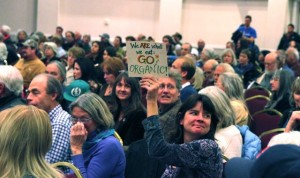
In Boulder, CO, the fight to keep GMOs off county lands is entering the final rounds. After months of deliberation, an agricultural policy group has recommended that GMOs be allowed on open space land and the people of Boulder county are making sure their leaders know they do not approve. Their message is being heard and the collective thorn is growing in Monsanto’s side. Will the county commissioners side with the corporations or the people?
The joint session of the Food and Agriculture Policy Council (FAPC) and the Parks and Open Space Advisory Commission (POSAC) saw a huge turnout Tuesday night at the Longmont Convention Center. The purpose of this meeting was to publicly present and receive comments on the current agricultural policy recommendations set forth by the members of the Cropland Policy Advisory Group (CPAG). The Boulder Cropland Policy encompasses many aspects of agriculture, but the main issue is whether to let farmers grow GMO crops on public open space land. While this group could not come to a consensus on the GMO issue, the majority of the members recommended that GMOs be allowed on open space land.
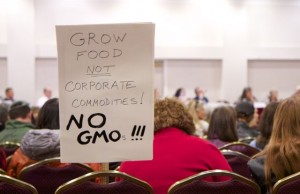
Boulder, known for its progressive stance on sustainability and the environment, naturally attracts more health-oriented people than the national average. Local surveys have shown that 71% of the people do not approve of GMOs being grown on county land. Proponents for both sides of the issue were in attendance, but the crowd’s reaction to the meeting’s proceedings made it overwhelmingly clear who was the majority. Concerned citizens arrived carrying posters and the applauses for non-GMO statements were so long and numerous, the facilitator requested they be withheld.
Each citizen was given three minutes to speak. The vast majority expressed their concerns about the safety of GMO crops, their associated chemical application, and possible contamination issues. They spoke out against the conflict of interest, political influence and corporate greed that has affected national GMO public policy.
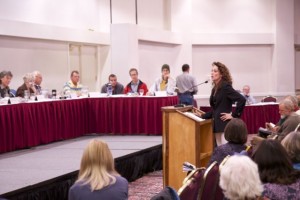
Members of the Boulder GMKnow Group, a local non-GMO awareness group organized by Scott and Mary Smith, were not satisfied with the recommended agricultural policy and wrote their own. This new policy, called the Citizens Cropland Policy was read by 25 members in 3-minute intervals and is available for viewing and endorsement on their website.
The opposite camp showed up as well. Standing out like sore thumbs, the large men, wearing blazers and cowboy hats, stood mostly in the back of the room. Their arguments were that GMOs made it easier for them to make more money.
During the public comments, an unidentified man in red shirt, who expounded on the benefits of GMOs to the panel, was later questioned as to his affiliations by an elderly man in the crowd. The red-shirted man pushed the elderly man and told him to “sit down”. It was later revealed to the panel that the red-shirted man is a Monsanto employee.
“It was a perfect ending to a glorious demonstration of citizens in action,” Smith said.
Prior to the altercation, representatives from the Colorado Farm Bureau spoke up in defense the GMO technology, stating that the existing science speaks for itself.
Good science does speak for itself, but has the GMO science been “good science”? Many, including the scientists doing the research, believe that not to be the case.

The safety of GMO crops depends on who you talk to. All studies conducted on the safety of GMOs have been conducted and/or funded by the very companies selling them. Since GMO crops were planted 15 years ago, companies such as Monsanto, Syngenta and DuPont have made it impossible for studies to be conducted without their authorization because of a “Technology/Stewardship” agreement that prohibits using their product for research. These policies came under scrutiny when 24 scientists anonymously contacted the EPA in February 2009 regarding unethical controls on scientific research. Elson Shields of Cornell University’s Department of Entomology, one of the formerly anonymous twenty-four, worked around the companies’ restrictions for 10 years but felt that too many issues were going unanswered. The scientists could not be assured that multi-year studies would be renewed or that the companies would give approval to follow up on unexpected findings. The companies have since implemented Academic Research Licenses (ARLs) to improve the issue, but these licenses are still restrictive in approved areas of study and require negotiation with the companies.
Still, these roadblocks have not stopped some international scientists from inquiring deeper into the issue. Russian biologist Alexey V. Surov of Surov’s Institute of Ecology found that hamsters fed a diet of GM soy developed infertility, slower growth, higher mortality rate and hair growing within the mouth. Another study by Gilles-Eric Séralini, published in the International Journal of Biological Sciences, found that Monsanto’s GMO corn was linked to organ failure in rats.
Perhaps the biggest concern citizens should ponder is not the effects of ingesting the genetically altered food, but the effect on the human and environmental health of the community. Earth Open Source published a report in June 2011 showing that Roundup, Monsanto’s trade name for glyphosate, causes birth defects. All available varieties of GMO seeds require the application of this chemical. It’s widespread application in association with GMO crops has also been linked to the dramatic rise of “superweeds” which do not respond to herbicide application.
The European Union, as well as most of the planet, continues to ban GMO crops. One has to wonder why, in the face of so many questions, our own government is trying to push them down our throats?
The FAPC and the POSAC will meet November 16th and 17th to decide on approving the policy recommended by CPAG. The policies will then be presented in public hearing to the Boulder County Board of County Commissioners on December 8th at 6pm at the Longmont Convention Center.
The citizens of Boulder county have made it loud and clear how
they feel on the GMO issue. But ultimately, the final decision on
which policy to accept lies in the hands of the three county
commissioners. Political influence has been traditionally stacked in
favor of the biotechnology corporations due to multimillion dollar
lobbying budgets and insider connections. Many other local
governments are looking to Boulder to set the precedent on this and
you can be sure Monsanto has assigned some lobbyists to this case.
Two of the three commissioners are up for re-election in 2012.
There are a lot of forces at play here, and given the huge local
response to this issue, this could go either way.
Correction: “Two commissioners are not up for re-election; Will Toor and Ben Pearlman are term-limited at the end of 2012.” – Garry Sanfacon (see comments)
Copyright © 2011 Food Integrity Now.