Greek PM Papandreou 'ready to drop' bailout referendum
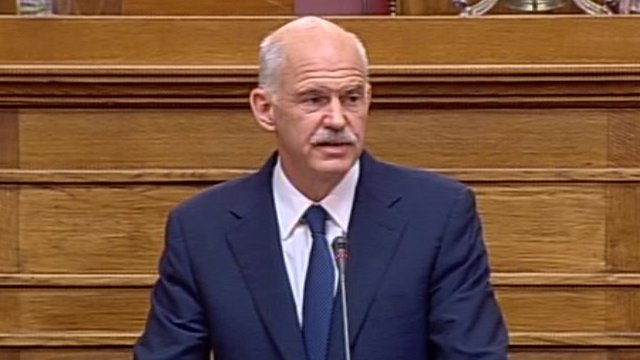
Mr Papandreou addressed members of his Pasok party in parliament
Greek PM George Papandreou has said he is ready to drop a proposed referendum on the country's eurozone bailout deal.
He said he was focusing on talks to secure opposition support in parliament which would make the vote unnecessary.
His announcement of a referendum angered European leaders and sent shockwaves through its markets.
The main opposition has called for his resignation and snap elections, and walked out of a debate in parliament ahead of a confidence vote on Friday.
Mr Papandreou's Socialist party (Pasok) holds a slim majority in parliament, 152 out of 300 seats.
New Democracy leader Antonis Samaras said Mr Papandreou had "nearly destroyed Europe and the euro" with his call for a referendum.
Mr Papandreou told MPs it would be irresponsible for the government to resign but that he was "not clinging on to any chair".
He said talks with the opposition on forming a "broader scheme" - apparently meaning a coalition government - should start immediately.
The BBC's Mark Lowen, in Athens, says that the prime minister hopes that if the threat of a referendum fades he can yet steer the country through the crisis.
Stark messageThe EU bailout deal, agreed last month, would give the heavily indebted Greek government 130bn euros (£111bn; $178bn) and it imposes a 50% write-off on private holders of Greek debts, in return for deeply unpopular austerity measures.
EU leaders say Greece cannot get bailout cash until there is clarity on the referendum issue.
Responding to the recent developments in Greece, French President Nicolas Sarkozy said that after talks with Mr Papandreou on Wednesday there was more of a sense of urgency in the country.
"I think the message that was sent to the entire Greek political class yesterday by Germany and France together has helped in a sort of realisation of how things might develop and in Greece they have realised this," he told reporters at the G20 summit in
Finance Minister Evangelos Venizelos, addressing Pasok MPs earlier, said Greece must say it was not holding a referendum.
He said Greece must do everything it can to reassure its international partners it will immediately implement the Eurozone bailout deal.
Mr Papandreou told the gathering the referendum on the deal was never an end in itself, and there were two other choices - an election, which he said would bankrupt the country, or a consensus in parliament.
"If we had a consensus we wouldn't have to go to a referendum," he said.
"If the opposition is willing to negotiate then we are ready to ratify this deal and implement it."
Analysis

This has been a day of intense uncertainty and speculation in Athens.
Speculation ran rife that Mr Papandreou was preparing to resign and call for a national unity government. But that was officially denied by his spokesman. The prime minister addressed parliament to calm nerves. He raised the possibility the referendum could be abandoned and last week's debt deal accepted.
But tonight there is a sense that Greece is becoming yet further embroiled in political instability which it can ill afford. Greeks and all of Europe are looking on anxiously. The reverberations of what happens in the next few hours will be felt far beyond Greece's borders.
He said talks with the opposition on forming a "broader scheme" - apparently meaning a coalition government - should start immediately.
The BBC's Mark Lowen, in Athens, says that the prime minister hopes that if the threat of a referendum fades he can yet steer the country through the crisis.
Stark messageThe EU bailout deal, agreed last month, would give the heavily indebted Greek government 130bn euros (£111bn; $178bn) and it imposes a 50% write-off on private holders of Greek debts, in return for deeply unpopular austerity measures.
EU leaders say Greece cannot get bailout cash until there is clarity on the referendum issue.
Responding to the recent developments in Greece, French President Nicolas Sarkozy said that after talks with Mr Papandreou on Wednesday there was more of a sense of urgency in the country.
How Greek drama unfolded
- 0839: Mr Papandreou calls emergency cabinet meeting.
- 0844: Socialist (Pasok) MP Eva Kaili says she will not support government in Friday's confidence vote.
- 0858: Pasok MP Dimitris Lintzeris calls on Mr Papandreou to resign.
- 1115: Senior Pasok MPs prepare proposal for coalition government.
- 1154: State TV says Mr Papandreou to visit President Karolos Papoulias, fuelling rumours he will resign.
- 1342: President's office says it has no meeting scheduled with prime minister.
- 1512: Mr Papandreou says if opposition backs EU bailout deal in parliament, no referendum necessary.
- 1608: Mr Papandreou tells Pasok MPs Greece's euro membership at stake in referendum.
- 1640: Finance Minister Evangelos Venizelos says Greece must abandon plans for referendum.
- 1800: Mr Samaras demands resignation of prime minister and snap election.
BBC © 2011 The BBC is not responsible for the content of external sites. Read more.