National Instruments signs to do E-Cat controls
Today, Andrea Rossi signed an agreement with National Instruments to have them make all of the instrumentation for the E-Cat cold fusion plants, which began to be sold commercially on October 28 with the first 1 MW plant successfully tested in Bologna.
|
|
|
| Full Disclosure: PES Network has a business relationship with Andrea Rossi. |

By
Sterling D. Allan
Pure Energy Systems News
Today, Leonardo Corporation, led by Andrea Rossi, inventor and
developer of the one-megawatt cold fusion
E-Cat plant, signed an agreement with National Instruments (NI), to
have them make all the instrumentation for the E-Cat plants, which began
commercial sales on
October 28, following the successful test in Bologna, Italy of the
first 1 MW heat plant to the first customer.
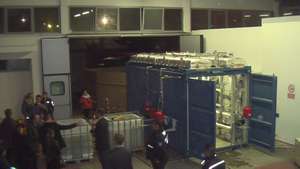
The 1 MW plant, which is the size of a small shipping container, and
said to produce about as much power as a small locomotive, is made up of
around 100 modules, each containing three reactors acting in parallel
that combine hydrogen and nickel (a special micro powder preparation)
into copper in the presence of a proprietary catalyst and a radio
frequency stimulator, beginning at around 450 degrees Celsius. The
initial heating is supplied electrically from resistive heaters. Once
the nuclear reactions commence, the start-up electrical energy source
can be disconnected, and the self-sustaining reaction can be controlled
by the amount of hydrogen pressure supplied to the chamber.
No nuclear waste is emitted, and no radioactive elements are required in
the reaction. The gamma radiation produced during operation, which
results in the copious heat generated, is shielded by two layers of thin
lead.
According to Rossi, NI will be creating the controls to monitor and
regulate this process.
He said that their stipulation for the agreement is that all the
instrumentation for the E-Cat plants have "by National Instruments" and
logo on the instrumentation panels.
National Instruments, headquartered in Austin, Texas, USA, was
established in 1976, and conducts global operations in 41 countries,
with over 5,000 employees. In 2010, the company sold products to more
than 30,000 companies in 91 countries with revenues of $860 million. (Wikipedia)
Concezzi said that their customers include Boeing and Airbus, and that
they have employees separated who are working on competitor technologies
so that there is not a conflict of interest.
Fortune magazine has recognized NI in its list of "100 Best
Companies to Work For" for the past 12 consecutive years. Their
website presently lists 111 job
openings.
According to their website:
National Instruments transforms the way engineers and scientists around the world design, prototype, and deploy systems for test, control, and embedded design applications. Using NI open graphical programming software and modular hardware, customers at more than 30,000 companies annually simplify development, increase productivity, and dramatically reduce time to market. From testing next-generation gaming systems to creating breakthrough medical devices, NI customers continuously develop innovative technologies that impact millions of people.
Their "Big Physics" page mentions that they are involved in providing instrumentation solutions to projects including particle accelerators, fusion reactors, and telescopes. Their fusion page says:
"At the Max Planck Institute for Plasma Physics in Garching, Germany, researchers implemented a tokamak control system to more effectively confine plasma. For the primary processing, they developed a LabVIEW application, which split up matrix multiplication operations using a data parallelism technique on an octal-core system. Researchers installed a hard real-time operating system (OS) with symmetric multiprocessing (SMP) support on an off-the-system based on an Intel multicore architecture. Researchers on the project were able to speed up the matrix multiplication operations by a factor of five while meeting the 1 ms real-time control loop rate."
That a company of this caliber would get involved with such a
groundbreaking technology that has been surrounded by so much skepticism
and criticism, says a lot for its actual credibility. And it speaks to
the bright future that is emerging as clean, affordable energy solutions
finally begin to break into the marketplace.
The international Tokomak project in France is a multi billion dollar
hot fusion project that isn't expected to achieve overunity for many
years. As we noted in a
story last July:
The [ITER] reactor is being financed by countries around the world including the United States, the European Union, and China. This extremely expensive reactor is expected to cost over 15 billion Euro to build, and will require even more funding to operate. It is hoped that construction will be finished by 2018, and the reactor can be tested by 2019. After many years of testing, the ITER reactor might meet the goal of producing ten times more power than it consumes.
In contrast, the E-Cat, at a minute fraction of the cost, has
apparently already achieved that milestone, and is in the market. The
first one-off plants cost 2,000 Euros per kilowatt, or 2 million for the
1 MW plant. But once mass produced, Rossi expects the cost to go down to
100 Euros per kilowatt installed -- a tenth of what coal or natural gas
power plants costs, minus the fuel costs.
So you could see why National Instruments would be interested in getting
in on the ground floor.
I phoned NI headquarters and they put me in touch with the NI person in
Italy who Andrea Rossi named to me in a Skype conference call today; and
that person confirmed the customer relationship. I talked to two
additional people as well.
Stefano Concezzi, who serves as NI's Director of Science and
Big Physics Segment, told me that NI
does not comment on contracts made with customers, unless the customer
requests a press release; but he could confirm that Andrea Rossi is a
customer.
"I would love for him to be right.
"We support every kind of research for the betterment of human kind. Whoever is interested in doing that, we would be happy to support."
So at this time, I would gather that their contract should not be
construed as a validation or confirmation of the E-Cat science, but a
signal of NI's willingness to help Rossi develop the technology into an
even more robust embodiment, to help increase its operational stability,
reliability, safety; while lowering its price point.
Postscript:
On November 10, 2011 4:39 PM [MST], regarding the above story, I
received the following from Trisha McDonell | Corporate PR Manager |
National Instruments.
Subject: Re: final Re: contact info for E-Cat / NI contract
Thank you Sterling for allowing us to review. We approve the text, especially the National Instruments portion of the story that includes Stefano's quote and information.
Best regards
Trisha
# # #
This story is also published at
BeforeItsNews.
[ed: For a Video discussion of the E-Cat and its most recent test go to: http://www.ecat.com]
www.pureenergysystems.com
PES Network, Inc.
Copyright © 2003 - 2011