E-Cat Test Validates Cold Fusion Despite Challenges
The test of the E-Cat (Energy Catalyzer) that took place on
October 6, 2011 in Italy has validated Andrea Rossi's claim that the
device produces excess energy via a novel Cold Fusion nuclear reaction.
Despite its success, the test was flawed, and could have been done in a
way that produced more spectacular results -- as if confirmation of cold
fusion is not already stunning enough.
 Andrea Rossi stands in front of his E-Cat apparatus, October 6, 2011 Photo by Maurizio Melis of Radio24 |
by Hank
Mills
for Pure Energy Systems News
Andrea Rossi has made big claims for the past year, about his cold
fusion "E-Cat"
(Energy Catalyzer) technology. He has claimed that it produces vast
amounts of energy via a safe and clean low energy nuclear reaction that
consumes only tiny amounts of nickel and hydrogen. A series of tests had
been performed earlier this year that seemed to confirm excess energy is
produced by the systems tested. Some of the tests were particularly
impressive, such as one that lasted eighteen hours, and was performed by
Dr. Levi of the University of Bologna. Unfortunately, the tests were not
planned out as well as they could have been and had flaws.
The most recent test that took place on October 6, 2011 in Bologna,
Italy, was supposed to address many of the concerns about the previous
tests, and be performed in a way that would put to rest many issues that
had been discussed continually on the internet. Despite showing clear
evidence of excess energy -- which is absolutely fantastic -- this most
recent test failed to live up to its full potential. It was a big
success in that it validated the claim the E-Cat produces excess energy
via cold fusion, but it was not nearly as successful as it could have
been. Or as successful as we, the outsiders looking in, would like for
it to have been.
The Inventor's Mindset
One thing that should be stated is that inventors do not always think
like the people who follow their inventions. They have their own mindset
and way of looking at things. This should be obvious, because they are
seeing *everything* from a different perspective. For example, when we
think seeing the inside of an important component would be exciting and
informative, they consider it a threat to their intellectual property.
Or, for example, when we would like to see a test run for days, they are
thinking that a few hours is long enough. In their mind, they know their
technology works, and running it for hours, days, or weeks would be more
of a chore to them than an exciting event.
In Rossi's case, he has worked with these reactors for many years. He
has tested them time and time again. In fact, he has built hundreds of
units (of different models), and has tested every one of them. He is
aware of how the units operate and how they perform. Actually, for a
period of many months to a year or more, he had an early model of E-Cat
heating one of his offices in Italy. Satisfying the curiosity of
internet "chatters" by operating a unit for an extended period of time
-- beyond what he thinks is needed to prove the effect -- is just a
waste of his time, according to his thinking. He could spend the time
getting the one megawatt plant ready to launch.
Don't forget, Rossi is a busy person. In addition to finishing the one
megawatt plant, he has a new partner company to find, a wife at home,
and a life to live! We need to consider that he works sixteen to
eighteen hours a day building units, testing them, addressing other
issues about the E-Cat. Although he is a very helpful person in many
ways (willing to communicate with people and answer questions), he
simply does not have the time to grant all of the many requests made of
him. If he did, he could not get any work done at all, and the E-Cat
would never be launched, or ever make it to the market place!
The Outsider's Mindset
I consider myself an outsider. I have never built a cold fusion device,
have never spent years working to develop a technology, and have never
gone through the grueling process of trying to bring a product into the
market place. Although I spend a lot of time researching various
technologies on the internet, I don't work sixteen to eighteen hours a
day. In addition, I have no vested interest in the success of any
technology, other than simply wanting at least one to hit the market
place, ASAP.
As an outsider, I do not think like Rossi thinks. I don't think the
majority of people think like Rossi thinks, because they are not in his
shoes. They are not working to the point of exhaustion, and do not have
years of their life invested in an exotic technology. Due to the fact we
do not think like Rossi, his actions or sometimes lack thereof can seem
strange, bizarre, or odd. Sometimes, they can make us want to smack
ourselves, to make sure we are not in some sort of strange dream.
The recent test on October 6, 2011 is an example of a situation in which
outsiders would have liked to have seen a very different test. Here are
examples of how an outsider would have liked to see the test performed,
compared to Rossi's possible mindset.
(Please note that I am making speculations about what Rossi is thinking,
and his mindset. I do not know for sure if my guesses are accurate. If
they are not, then I would like to apologize to Rossi, and give him the
chance to respond in any way he sees fit.)
Full Power
In the recent test, the output producing capability of the reactors was
throttled down for safety reasons. This may have been done by keeping
the hydrogen pressure low, or adding less of the catalyst to the nickel
powder. Also, only one out of the three reactors that were inside of the
module, were used in the test. For an experimental test to prove the
effect beyond a shadow of a doubt, I, as an outsider, would have loved
to have seen the device fully throttled up, despite the safety risks.
Even if it meant everyone that attended would have had to sign long
legal disclaimers, it would have been worth it.
I think it would have been great if all three reactors were utilized,
and they all were adjusted to produce their maximum level of output.
This would have increased the amount of output produced dramatically,
and would have reduced the amount of input needed. The more heat
produced by the system, the less heat would have needed to be input via
the electric resistors.
Rossi, on the other hand, probably thought throttling up the device to a
high level was not worth the risk, and was not needed to prove that
excess energy was being produced. It is true that an explosion causing
injuries -- while probably VERY unlikely -- could result in a setback of
his project, and possible legal ramifications. Also, in reality, the
test proved excess energy was being produced even with only one,
throttled down reactor being used.
So even though a test of the device adjusted to operate at full power
would have been useful and exciting, it was not absolutely needed for
what Rossi wanted to accomplish.
I would like to ask Rossi to consider performing a demonstration with a
module both adjusted to operate at full power, and utilizing all three
reactor cores. Even if he has to limit the number of people involved,
perform the test remotely with cameras monitoring the module, utilize a
blast shield, or only allow certain individuals (who have signed
disclaimers) to go into the room in which the module is running.
A Longer Self Sustain
As an outsider, I have not had the chance to look at test data from
these devices self-sustaining for long periods of time -- 12 hours, 24
hours, days, weeks, etc. I would really like to see one of these units
self sustain for a *very* long period of time. This is not because I
think the output of the E-Cat during the recent test was due to stored
energy being released (the 'thermal inertia' theory being floated around
the internet). In fact, I think that the flat line in NyTeknik's graph
-- showing self sustain mode for three and a half hours without any drop
in output temperature -- provides clear evidence against the thermal
inertia theory. The reason I would like to see a longer period of self
sustain, is that it would not only document a huge gain of energy, but
one that no individual could rationally deny!
Rossi has claimed that these devices represent an alternative energy
solution that could change the world. I think this is true. However, to
show just how much potential this technology has, an even more extended
test of the E-Cat in self sustain mode (at full power or at least with
all three reactors inside the module being used), would have been much
more impressive. I am not saying the Oct. 6 test was not impressive --
it was very significant because it demonstrated excess energy and proof
of cold fusion -- but that a longer test would have been better. It
would have done more to shut up the cynics (a few of which will never
change their minds), and help the technology get into the mainstream
(dumbstream) media.
I really don't think Rossi cares too much about showing off the
technology's full potential, at this point. He also does not seem to
appear to want the attention of the mainstream media, or at least any
more than he thinks he needs. If he did, the test would have been far
different, and would have produced such a gigantic amount of excess
energy everyone's jaws would have dropped. My jaw dropped when I saw the
flat line during self sustain mode (because it proved beyond a doubt the
system was producing excess energy), but my jaw did not drop as far as
it could have, if the period of operation had lasted longer.
Interestingly, I have known inventors, of unrelated energy technologies,
that purposely held back from showing the *best* version of their
technology. They did not want to show off too much, because they did not
want to deal with the fallout of attracting too much attention. Instead
of performing an amazing demonstration, they performed one that proved
the point -- at least to their satisfaction -- but would not attraction
too much attention. I think Rossi may feel the same way. If he had his
way, he would have never done a single test before the launch of the one
megawatt plant. It was Focardi that convinced him to do a public test,
because he feared that (due to health problems) he may not live long
enough to see the technology be revealed to the world.
A longer test (at least 12 hours) in self sustain mode would have been
great, exciting, and would have produced even more excess energy.
However, in Rossi's mind, it was not needed, for potentially valid
reasons (at least from the perspective of someone on the inside).
I would simply like to humbly plead with Rossi, to try and step in the
shoes of the outsider, and at the next test allow the module to run for
a longer period in self sustain mode.
Modern Testing Methods and Tools
I have looked at the data acquired during the test, but have not had a
chance to study it as in depth as I would like to. The data shows a
clear gain of energy in my opinion, and confirms that the E-Cat is
producing excess energy. As I said before, the test was a success.
However, it could have been performed in a more modern way.
For example, all of the temperature measurements, power input
measurements, and water flow measurements should have been fed into the
same computer, to be recorded in a real time manner. This way all the
data would have been automatically recorded into one data set, including
the hour and second of every measurement. It seems data collection was
not done this way at the test, and some of the data was actually taken
by hand!
Because the data was not all automatically recorded into one computer
during the test, NyTeknik (who had the exclusive right to be the first
to post a report on the test) has not yet posted a graph that charts all
the measurements of all the factors of the test. What I would like to
see is a single high resolution graph, that shows all of the
measurements that were taken of every parameter of the test. If one
graph showing everything would be too complex for a non-expert to easily
interpret, then a series of graphs would be ideal. This would allow
everyone to more simply determine the total energy in, and the total
energy out.
The data collected and the manner in which it was collected is good
enough to show there was a significant amount of excess energy produced,
especially during self sustain mode. It may also be good enough to show
even more details about the excess energy produced. Sadly, I'm not an
expert in scientific data interpretation, so it takes me more time to
interpret data than an expert who does so full time (like Rossi).
I hope that when I have had the time to examine the data in more depth,
I will see that Rossi's claims about the results of the test (not just
excess energy but a six fold gain of energy, in a worst case scenario)
are accurate. At this point, I am not going to doubt him. He is the
expert, and there are many people going over the data, and hopefully
more data from the test will be coming in the near future.
What I would like to do, is request that he upgrade his data acquisition
methods for any upcoming public tests. However, from Rossi's
perspective, the way the data was acquired was good enough, and proved
the point he wanted to make. I respect his view, but I do hope that he
will change his mind in the future.
For the record, I am not stating that I think better data acquisition
techniques are needed to verify his technology produces excess energy,
and even significant amounts of it. I simply think it would make
analysis of test data much simpler, quicker, and precise.
No Control
One of the most useful tools in the scientific method is a control. A
control is an object or thing that you do not try to change during the
experiment. For example, if you were giving an experimental drug to a
hundred people, you might want to have a number of additional people who
do not receive the drug. You would compare how the drug effects the
people who consumed it, to those who did not receive the drug at all. By
comparing the two sets of people, those who consumed the drug and those
who did not, you could more easily see the effectiveness of the drug --
or if it was doing harm.
In Rossi's test, a control system would have been an E-Cat module that
was setup in the exact same way, except it would have not been filled
with hydrogen gas. It would have had the same flow of water going
through it, the same electrical input, and it would have operated for
the same length of time as the E-Cat unit with hydrogen. By comparing
the two, you could easily see the difference between the "control" E-Cat
(that was not having nuclear reactions take place), and the "real" E-Cat
(that was producing excess heat).
If a control had been used in the experiment, the excess heat would be
even more obvious. It would have been so obvious, that it could have
made the test go from a major success (with some flaws), to the most
spectacular scientific test in the last hundred years.
Yes, a control would have made that much of a difference!
I understand that Rossi may not see the need for a control, when the
test that was performed clearly showed excess energy without it. A
control might have made the experiment so mind blowingly amazing, it
could have attracted too much media attention, too many scientists that
would want to get involved, and too many individuals wanting additional
information. The result could have been that Rossi would not even have
the time to finish his one megawatt plant.
However, from the view point of an outsider, I think a control would
have greatly benefited the experiment. If it created too much media
attention, perhaps someone could volunteer to work for a month as an
unpaid intern, filtering through all of the requests from media
representatives, and taking care of many non-technical tasks, so Rossi
could focus on getting the one megawatt plant ready!
I sincerely hope that during the test of the one megawatt plant, and any
tests before then, a control run will be performed, in which no hydrogen
is placed in the reactors.
Rossi's Statement about the Test Results
Andrea Rossi responded to an email we sent him that had questions about
the test. Here is the email, and his responses.
DEAR ALL,
THANK YOU FOR YOUR CONTINUOUS ATTENTION. PLEASE FIND THE ANSWERS IN BLOCK LETTERS ALONG YOUR TEXT:
Dear Andrea Rossi,
In regards to the latest test of the Energy Catalyzer, I have a number of questions I hope you can answer.
1) My understanding is that if a reactor core is not adjusted to be under-powered (below its maximum potential) in self-sustain mode, it can have a tendency to become unstable and climb in output. If the reactor is left in an unstable self-sustaining mode for too long, the output can climb to potentially dangerous levels. Can you provide some information about how the reactor core in the test was adjusted to self-sustain in a safe manner?
NO, VERY SORRY
a) For example, there was only one active reactor core in the module tested. How was the single reactor core adjusted to be under-powered?
CONFIDENTIAL INFO
b) Is adjusting the reactor core as simple as lowering the hydrogen pressure?
2) What is the power consumption of the device that "produces frequencies" that was mentioned in the NyTeknik article? Although the power consumption of this device is probably insignificant, providing a figure could help put to rest the idea (that some are suggesting) that a large amount of power was being consumed by the frequency-generating device, and transmitted into the reactor.
THE ENERGY CONSUMED FROM THE FREQUENCY GENERATOR IS 50 WH/H AND IT HAS BEEN CALCULATED, BECAUSE THIS APPARATUS WAS PLUGGED IN THE SAME LINE WHERE THE ENERGY-CONSUME MEASUREMENT HAS BEEN DONE
a) Can you tell us anything more about this frequency generating device and its function?
NO, SORRY, THIS IS A CONFIDENTIAL ISSUE
b) Is the frequency-generating device turned on at all times when a module is in operation, or only when a module is in self-sustain mode?
CONFIDENTIAL ISSUE
c) Some are suggesting that this device is "the" catalyst that drives the reactions in the reactor core. However, you have stated in the past that the catalyst is actually one or more physical elements (in addition to nickel and hydrogen) that are placed in the reactor core. Can you confirm that physical catalysts are used in the reactor?
YES, I CONFIRM THIS
3) Does the reaction have to be quenched with additional water flow though the reactor, or is reducing the hydrogen pressure enough to end the reactions on its own?
NEEDS ADDITIONAL QUENCHING
a) If reducing the hydrogen pressure (or venting it completely) is not enough to turn off the module, could it be due to the fact some hydrogen atoms are still bonded to nickel atoms, and undergoing nuclear reactions?
YES
b) If there is some other reason why reducing hydrogen pressure is not enough to quickly turn off the module, could you please specify?
Thank you for taking the time to answer these questions, and for allowing a test to be performed that clearly shows anomalous and excess energy being produced. Hopefully, the world will notice the significance of this test.
THANK YOU VERY MUCH, AND, SINCE I HAVE ABSOLUTELY NOT TIME TO ANSWER (I MADE AN EXCEPTION FOR YOU) PLEASE EXPLAIN THAT BEFORE THE SELF SUSTAINING MODE THE REACTOR WAS ALREADY PRODUCING ENERGY MORE THAN IT CONSUMED, SO THAT THE ENERGY CONSUMED IS NOT LOST, BUT TURNED INTO ENERGY ITSELF, THEREFORE IS NOT PASSIVE. ANOTHER IMPORTANT INFORMATION: IF YOU LOOK CAREFULLY AT THE REPORT, YOU WILL SEE THAT THE SPOTS OF DRIVE WITH THE RESISTANCE HAVE A DURATION OF ABOUT 10 MINUTES, WHILE THE DURATION OF THE SELF SUSTAINING MODES IS PROGRESSIVELY LONGER, UNTIL IT ARRIVES TO BE UP TO HOURS. BESIDES, WE PRODUCED AT LEAST 4.3 kWh/h FOR ABOUT 6 HOURS AND CONSUMED AN AVERAGE OF 1.3 kWh/h FOR ABOUT 3 HOURS, SO THAT WE MADE IN TOTAL DURING THE TEST 25.8 kWh AND CONSUMED IN TOTAL DURING THE TEST 3.9 kWh. IN THE WORST POSSIBLE SCENARIO, WHICH MEANS NOT CONSIDERING THAT THE CONSUME IS MAINLY MADE DURING THE HEATING OF THE REACTOR DURING THE FIRST 2 HOURS, WE CAN CONSIDER THAT THE WORST POSSIBLE RATIO IS 25.8 : 3.9 AND THIS IS THE COP 6 WHICH WE ALWAYS SAID. OF COURSE, THE COP IS BETTER, BECAUSE, OBVIOUSLY, THE REACTOR, ONCE IN TEMPERATURE, NEEDS NOT TO BE HEATED AGAIN FROM ROOM TEMPERATURE TO OPERATIONAL TEMPERATURE.
WARMEST REGARDS TO ALL, ANDREA ROSSI
He claims that the test produced 25.8 kilowatt hours of power, and
consumed only 3.9 kilowatt hours, not considering the losses from using
two circuits of water and a heat exchanger. This would be very
impressive for a system that is only using one reactor core (out of
three), that has been adjusted to only produce a fraction of its maximum
potential power.
However, from my analysis of the data so far (still trying to wrap my
head around it), I have not been able to confirm his claim of a COP of
6. I am not saying it is not the case, or not in the data. I simply have
yet to fully examine the data, and I am waiting for more data to be
released.
Actually, I hope that someone will release all the data in one file
and/or graph that will be easier to interpret. Perhaps NyTeknik, if they
have not done so already, could contact Rossi or someone else who
attended and recorded the data, and ask for any test data they are
missing.
Bottom Line - Cold Fusion Is Here
The fact of the matter was that the October 6th test was a success in
many ways.
- It documented a gain of energy.
- It documented a gain of energy in self-sustain mode.
- It documented massive "heat after death."
Most importantly, it proved beyond a doubt, that cold fusion is a
reality.
Italian scientific journalist Maurizio Melis of Il Sole 24 Ore, who
witnessed the test in Bologna,
wrote:
"In the coming weeks Rossi aims to activate a 1MW plant, which is now almost ready, and we had the opportunity to inspect it during the demonstration of yesterday. If the plant starts up then it will be very difficult to affirm that it is a hoax. Instead, we will be projected suddenly into a new energetic era."
The test could have been made better in many ways. It had flaws.
However, it was the most significant test of the E-Cat so far, for one
reason in particular....
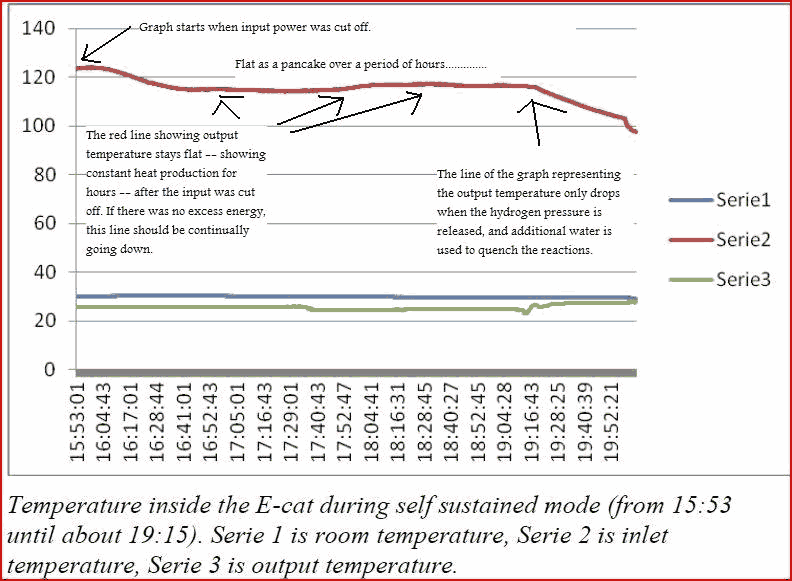
This graph shows that the E-Cat is a device producing excess energy,
because the red line does not go down until after the hydrogen is
vented.
- Some may legitimately argue about how much energy was produced,
because we don't yet have all the test data in one easy to interpret
graph or file.
- Some may point out the flaws in the test, such as the lack of a
control, the lack of another several hours of operation in self sustain
mode.
- Some may point out ways the test could be improved.
However, that graph by NyTeknik makes it clear the test was a success --
not a failure.
Mainstream media, your alarm clock is buzzing, it's time to wake up!
# # #
This story is also published at
BeforeItsNews.
www.pureenergysystems.com
PES Network, Inc.
Copyright © 2003 - 2011