On Solar and Solyndra
| 9.28.11 | Tam Hunt, President, Community Renewable Solutions, LLC |
Reports of the death of the solar industry are greatly exaggerated. Yes, there have been some high profile bankruptcies of US solar companies -- Solyndra, Evergreen, Spectrawatt -- in 2011. But the solar industry as a whole is on a boom that is only going to increase in coming years. We are in the elbow of an exponential solar growth curve that is going to transform how we produce and use energy.
This is great news for all energy users and the planet.
Solar has reached scale as a global industry, growing from its first gigawatt of annual installations in 2005 (enough to provide power for about 200,000 California homes) to over 28 gigawatts in 2011 (enough for almost 6 million homes), according to Bloomberg New Energy Finance projections. Cumulative installations will reach about 40 gigawatts by the end of 2011 -- power for 8 million homes.
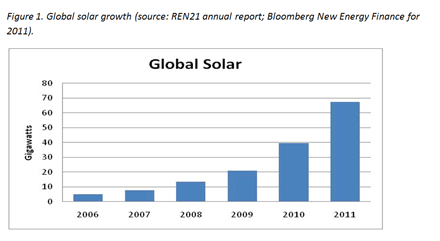
Global solar power has grown an average of 68 percent each year over the
last five years. This is a doubling literally every 1.3 years. So
today's 40 gigawatts of capacity becomes, under the same growth rate, an
astronomical 1.3 million gigawatts by 2030. Obviously, the recent rate
of growth won't continue because, among other reasons, this is far more
power than we need for the entire globe! But even if solar power's rate
of growth drops in half to 35 percent over the next two decades, this
produces a doubling every 2.3 years and we get 16,000 gigawatts (16
terawatts) by 2030 -- almost as much as the entire world will need by
then.
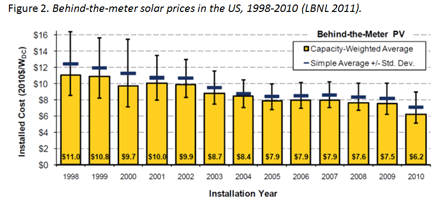
What about cost? A large part of why solar growth has been so strong in recent years is because prices have been declining dramatically in recent years. Lawrence Berkeley National Lab (LBNL) issues a solar power market report on the US market each year. Their latest report, released this month, shows that behind-the-meter solar project prices dropped almost by half from 1998 to 2010. The first half of 2011 saw yet another 11% drop in averages in California, the biggest market in the US, from $6.4 per watt to $5.7 per watt.
Behind-the-meter solar is important but is dwarfed globally by
utility-scale solar, and this emphasis on utility-scale solar will
probably increase in coming years due to the dramatic price declines
we've seen for solar. The public data for utility-scale solar is much
less comprehensive but prices are far lower for this segment due to
economies of scale. Utility-scale solar projects can be from one
megawatt to many hundreds of megawatts, compared to a couple of
kilowatts up to one or two megawatts for behind-the-meter projects.
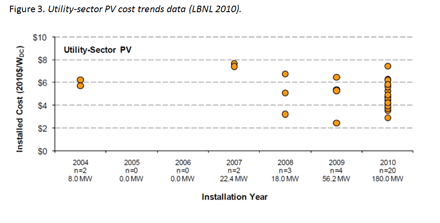
Average U.S. installed costs for utility-scale solar in 2010 were
between $3.8 per watt and $4.4 per watt, according to the National
Renewable Energy Laboratory. LBNL data show slightly higher costs in its
limited data set (figure 3). I have reliable anecdotal data that suggest
pricing for new projects to be completed in 2012 will be below $3 per
watt, reflecting panel prices as low as $1.15 per watt! Time will tell
if these last figures are accurate but the established declining cost
trends over the last ten years suggest they are.
What about grid parity? With all of these cost declines are we there
yet? It depends. Grid parity depends, of course, on what grid is being
considered. With federal tax benefits for solar (which apply also to
nuclear, for those who think commercial solar gets a leg up),
utility-scale solar projects may be at grid parity now in California. I
write "may be" because we have public data from very few completed
utility-scale projects in California, so we can't yet compare price
forecasts to actual prices. Such data will be available in the coming
year or so for a number of new projects.
Many utility-scale solar contracts have been approved by the California Public Utilities Commission at prices below grid parity (the "Market Price Referent"), when the federal tax benefits are included, but these projects haven't been built yet. Again, we'll have to wait and see if these contracts result in real projects.
The trend is very clear, however: we are, if not already there, well on our way to solar grid parity in California and other areas of the country that have high electricity rates. While tax benefits are a substantial factor in the viability of solar projects today, this will change quickly as prices diminish further. And this trend will expand geographically very quickly because solar production is ramping up so quickly around the world -- with the declining prices I've mentioned as the main benefit. My feeling is that by 2015-2020 solar projects in most western states, Hawaii and New England, will be at grid parity even without any subsidies.
The Solyndra debacle is unfortunate and I look forward to learning more about what went wrong, including whether there was any wrongdoing by Solyndra or the White House. But the Solyndra story is a small part of the global solar story, which is one of the few extremely encouraging trends in the U.S. and world today. Massive solar growth will grow domestic jobs, increase energy independence, reduce greenhouse gas emissions and, as we transition to electricity as a fuel for transportation, allow for the de-carbonization of our transportation sector also.

Copyright © 2002-2011, CyberTech, Inc. - All rights reserved.