Shale Gas Craze Gets Bigger
Companies mixing, matching to get ahead
Of all the bets on natural gas so far, nothing
tops that of Kinder Morgan. It has bid $21.1 billion
on El Paso Corp. in what would become the biggest
pipeline operator and the fourth biggest energy
company in North America.
The thinking there is that the newfound shale gas
supplies will lead to more development and cause the
demand for natural gas to escalate. Several factors
have inhibited that gas from getting to markets, two
of which have been the scarcity of pipelines and the
fragmentation of the industry itself. Not only does
consolidation give Kinder more resources to expand
its network but merging also helps the company
provide more seamless coverage.
“We believe that natural gas is going to play an
increasingly integral role in North America,” says
Richard Kinder, the company’s chief executive in
a public statement. “With the recent development of
shale resources, there are now abundant domestic
supplies of natural gas, which are being used
increasingly to generate electricity and are
environmentally friendly.”
According to the
U.S. Energy Information Administration, about 24
trillion cubic feet of natural gas was burned in
2010. And while the associated carbon emissions are
more than those tied to alternative energy forms, as
well as nuclear, they are still about half those of
coal. Coal now supplies about half of the country’s
electric generation while natural gas provides about
24 percent. The combination of new shale deposits
and stricter environmental controls means that the
former is expected to decline while the latter will
rise.
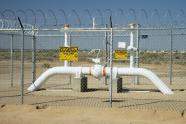
Kinder Morgan now operates 37,000 miles but through
the acquisition, it would increase that to about
67,000 miles. Kinder and El Paso, generally, operate
in disparate areas and Richard Kinder said during a
conference call that he did not expect U.S.
regulators to object because the two networks were
complementary. If they do raise concerns, the
company would oblige by selling off properties.
To pay for the proposed cash-and-stock deal that
could close by mid 2012, Kinder will borrow about
$11.5 billion. To offset that cost, however, Kinder
will sell El Paso’s exploration and production
business -- a trend that began prior to the
announcement of this deal. A combined company would
be worth $94 billion.
Power Race
While concerns exist that a larger company would
reduce competition and push up natural gas prices,
more analysts tend to think such scale would benefit
consumers. That’s because the stranded shale in
North Dakota’s Bakken field and in Texas’s Eagle
Ford, as well as through the 10-state Marcellus
region, could likely get new routes to reach hungry
power markets. The added supply would then cut home
heating prices.
ICF International has reviewed what the country
will need in terms of pipeline infrastructure, all
in a world where shale gas is expected to make up
two-thirds of the total natural gas mix by 2035. The
firm is assuming a price range of $4-$7 per million
Btus as well as an increase of 1.3 percent in the
expected electricity demand per year for at least a
decade.
To get there, the United States and Canada will
require an average yearly investment of $8.2
billion, or $205 billion over the next quarter
century. The industry has invested $8 billion during
a three year period from 2006 to 2010 -- a "strong
indication" that it will continue to make the
necessary capital allocations if the regulatory
environment permits, says ICF.
By 2030, the U.S. and Canada will need approximately
29,000 to 62,000 miles of additional natural gas
pipelines as well as 370 billion to 600 billion
cubic feet of additional storage capacity, says the
study. If the country does not to rise to the
challenge, it would create supply disruptions and
price volatility would increase.
“The good news is that the natural gas industry has
a proven track record of constructing and financing
this level of infrastructure,” says Don Santa, chief
executive of the
Interstate Natural Gas Association of America.
Companies will seek to expand their networks by
acquiring their competitors, as Kinder is trying
with El Paso and as Energy Transfer is doing with
Southern Union. And, they will also have to lay more
pipe, especially if they hope to capitalize on the
shale-gas craze. Merging, in fact, is expected to
give companies the financial muscle to get ahead,
which is why so many have occurred recently in the
utility and energy worlds.
Kinder’s foray embodies the view that natural gas
will lead the power race. Regulatory approval is
expected and would expedite that dynamic. The
momentum will therefore continue and prompt the
marriage of similar companies.
EnergyBiz Insider has been been nominated in 2010
and 2011 for Best Online Column by Media Industry
News, MIN. Ken Silverstein has also been named one
of the Top Economics Journalists by Wall Street
Economists.
Follow Ken on www.twitter.com/ken_silverstein
energybizinsider@energycentral.com
Ken,
As usual a good and fair article. One of your points
is outdated, though. You say "the associated carbon
emissions are...about half those of coal." This may be
true in terms of just the combustion of natural gas, and
with "conventional" gas that may be true enough.
However, more and more, the gas -- and certainly most
new gas -- is acquired from shale, using hydrauic
fracturing, or "fracking." In this process, 3.6 to 7.9%
of the gas leaks out. Natural gas is mostly methane,
which is some 22 times as potent as CO2 as a greenhouse
gas. This makes the carbon footprint at least equal to,
and probably about 20% greater than coal, according to a
new study from Cornell University. See:
"Methane and the greenhouse-gas footprint of natural
gas from shale formations"
http://www.springerlink.com/content/e384226wr4160653/
"Shale gas 'worse than coal' for climate"
http://www.bbc.co.uk/news/science-environment-13053040
"New
study questions shale gas as a bridge fuel"
http://thinkprogress.org/romm/2011/04/12/207875/shal-gas-bridge-fuel/

Copyright © 1996-2011 by
CyberTech,
Inc.
All rights reserved.
To subscribe or visit go to:
http://www.energycentral.com
To subscribe or visit go to:
http://www.energybiz.com
|