The production of this ingredient causes jaw-dropping amounts of
deforestation (and with it, carbon emissions) and human rights
abuses.
 October 24, 2011
On August 10, police and security for the massive palm oil
corporation Wilmar International (of which Archer Daniels Midland is
the second largest shareholder) stormed a small,
indigenous village on the Indonesian island of Sumatra. They
came with bulldozers and guns, destroying up to 70 homes, evicting
82 families, and arresting 18 people. Then they blockaded the
village, keeping the villagers in -- and journalists out. (Wilmar
claims it has done no wrong.)
The village, Suku Anak Dalam, was home to an indigenous group
that observes their own traditional system of land rights on their
ancestral land and, thus, lacks official legal titles to the land.
This is common among indigenous peoples around the world -- so
common, in fact, that it is protected by the
United
Nations Declaration on the Rights of Indigenous Peoples.
Indonesia, for the record,
voted in favor of the Declaration on the Rights of Indigenous
Peoples in 2007. Yet the government routinely sells indigenous
peoples' ancestral land to corporations. Often the land sold is
Indonesia's lowland rainforest, a biologically rich area home to
endangered species like the orangutan, Asian elephant, Sumatran
rhinoceros, Sumatran tiger, and the plant Rafflesia arnoldii,
which produces the world's largest flower.
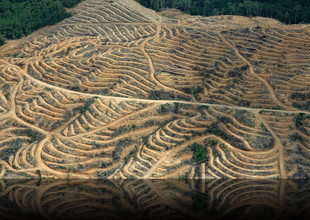
So why all this destruction? Chances are you'll find the answer
in your pantry. Or your refrigerator, your bathroom, or even under
your sink. The palm oil industry is one of the largest drivers of
deforestation in Indonesia. Palm oil and palm kernel oil, almost
unheard of a decade or two ago, are now unbelievably found in
half of all packaged foods in the grocery store (as well as
body care and cleaning supplies). These oils, traditional in West
Africa, now come overwhelmingly from Indonesia and Malaysia. They
cause jawdropping amounts of deforestation (and with it, carbon
emissions) and human rights abuses.
"The recipe for palm oil expansion is cheap land, cheap labor,
and a corrupt government, and unfortunately Indonesia fits that
bill," says Ashley Schaeffer of Rainforest Action Network.
The African oil palm provides two different oils with different
properties: palm oil and palm kernel oil. Palm oil is made from the
fruit of the tree, and palm kernel oil comes from the seed, or
"nut," inside the fruit. You can find it on ingredient lists under a
number of names, including palmitate, palmate, sodium laureth
sulphate, sodium lauryl sulphate, glyceryl stearate, or stearic
acid. Palm oil even turns up in so-called "natural," "healthy," or
even "cruelty-free" products, like Earth Balance (vegan margarine)
or Newman-O's organic Oreo-like cookies. Palm oil is also used in
"renewable" biofuels.
A hectare of land (2.47 acres) produces, on average, 3.7 metric
tons of palm oil, 0.4 metric tons of palm kernel oil, and 0.6 tons
of palm kernel cake. (Palm kernel cake is used as animal feed.) In
2009, Indonesia produced over 20.5 million metric tons, and Malaysia
produced over 17.5 million metric tons. As of 2009, the U.S. was
only the seventh largest importer of palm oil in the world, but as
the second largest importer of palm kernel oil, it ranks third in
the world as a driver of deforestation for palm oil plantations.
Indonesia has lost 46 percent of its forests since 1950, and the
forests have recently disappeared at a rate of about 1.5 million
hectares (an area larger than the state of Connecticut) per year. Of
the 103.3 million hectares of remaining forests in 2000, only 88.2
million remained in 2009. At that time, an
estimated 7.3 million hectares of oil palm plantations were
already established, mostly on the islands of Sumatra and Borneo.
Indonesia plans to continue the palm oil expansion, hoping to
produce an additional 8.3 million metric tons by 2015 -- this means
a 71 percent expansion in area devoted to palm oil in the coming
years.
At stake are not only endangered species and human lives, but
carbon emissions. One of the ecosystems at risk is Indonesia's peat
swamps, where soil contains an astounding
65 percent organic matter. (Most soils contain only two to 10
percent organic matter.) Laurel Sutherlin of Rainforest Action
Network describes the draining and often burning of these peat
swamps as "a carbon bomb." Destruction of its peat swamps as well as
its rainforests makes Indonesia the
world's third largest carbon emitter after the U.S. and China.
Among the horror stories coming out of Southeast Asian palm oil
plantations are accounts of
child slave labor. Ferdi and Volario, ages 14 and 21,
respectively, were each met by representatives of the Malaysian
company Kuala Lampur Kepong in their North Sumatra villages. They
were offered high-paying jobs with good working conditions, and they
jumped at the opportunity. According to an account by Rainforest
Action Network: "The two worked grueling hours each day spraying oil
palm trees with toxic chemical fertilizers, without any protection
to shield their hands, face or lungs. After work, Ferdi and Volario
were forced inside the camp where they'd stay overnight under lock
and key, guarded by security. If they had to use the bathroom,
they'd do their best to hold it until morning or relieve themselves
in plastic bags or shoes." They escaped after two months and were
never paid for their work.
What is the industry doing about such horrific claims? It has
established the Roundtable on Sustainable Palm Oil (RSPO). Kuala
Lampur Kepong, Wilmar International, and Archer Daniels Midland are
all members, and so are their customers, Cargill, Nestlé and
Unilever, as well as environmental groups like the World Wildlife
Fund and Conservation International. But, according to Sutherlin,
membership in RSPO means nothing -- other than that an organization
paid its dues. "That's the first level of greenwash," says
Sutherlin.
RSPO certifies some products and companies, and Sutherlin says
that does have some meaning, but leaves major loopholes open. For
example, there are no carbon or climate standards, and there have
been problems with the implementation of social safeguards. "It's
been a spotty record about their ability to enforce the standards
for how people are treated and how communities are affected," notes
Sutherlin. Yet, he says, RSPO is "the best game in town."
Rather than simply relying on RSPO's certification, Rainforest
Action Network has focused its campaign on the U.S. agribusiness
giant Cargill, which has a hand in fully
25 percent of palm oil
on the global market. Rainforest Action Network is asking Cargill to
sign on to a
set of social and environmental safeguards and to provide public
transparency on its palm oil operations. If Cargill cleans up its
act, perhaps it will help put pressure on other major multinationals
like Unilever, Procter & Gamble, and Nestlé, which also source palm
oil from unethical suppliers like Wilmar International.
Journalists have also criticized environmental groups for "cozy
relationships with corporate eco-nasties." The World Wildlife Fund
has
come under attack for its partnership with Wilmar, the
corporation that attacked a Sumatran village. Its involvement in
RSPO serves as a reminder of the accusations in a 2010
Nation article, which claimed that "many of the green
organizations meant to be leading the fight are busy shoveling up
hard cash from the world's worst polluters--and burying
science-based environmentalism in return." (WWF says it received no
payment from Wilmar in this particular case.)
The ugly issue of palm oil even touches the beloved American
icon, the Girl Scout cookie. When Girl Scouts Madison Vorva and
Rhiannon Tomtishen began a project to save the orangutan for their
Bronze Awards, they discovered the link between habitat loss and
palm oil. Then they looked at a box of Girl Scout cookies and found
palm oil on the list of ingredients. The two 11-year-olds -- who are
now ages 15 and 16 --
began a campaign to get the Girl Scouts to remove palm oil from
its cookies.
It took five years to get a response from the supposedly
wholesome Girl Scouts USA (whose 2012 slogan is "Forever
Green"). While the organization ignored its own members for
several years, it was unable to ignore the coverage the girls
received from Time magazine, the Wall Street Journal,
and several major TV networks. Once the story was so well-covered by
the media, Girl Scouts USA responded, promising it would try to move
to a sustainable source of palm oil by 2015. In the meantime, it
would continue buying palm oil that could have come from deforested
lands or plantations that use child slave labor, but would also buy
GreenPalm certificates, which fund a price premium that goes to
producers following RSPO's best practice guidelines.
So what should consumers do? For the time being, avoiding
products containing palm oil is probably your best bet. Since palm
oil is so ubiquitous this will likely mean opting to buy fewer
processed foods overall. Don't forget to check your beauty and
cleaning products, too. In a handful of cases, such as
Dr.
Bronner's soaps, palm oil comes from fair trade, organic
sources. But this is hardly the norm, and with the immense amount of
palm oil used in the U.S., it's unlikely that sustainable sources
could cover all of the current demand.
Jill Richardson is the founder of the blog
La Vida Locavore
and a member of the Organic Consumers Association policy
advisory board. She is the author of
Recipe
for America: Why Our Food System Is Broken and What We Can Do to
Fix It..
http://www.alternet.org