22 Shiite pilgrims found dead
|
BAGHDAD (AP) -- Iraqi authorities questioned a suspect Tuesday in the execution-style killings of 22 Shiite pilgrims by gunmen who hijacked their bus at a fake checkpoint.
An Iraqi lawmaker briefed on the investigation of Monday's attack said the suspect was found with weapons in his car near the spot on a desolate desert highway in western Iraq where gunmen forced their way on to the bus.
Shiite pilgrims have been a favorite target for Sunni insurgents trying to revive the sectarian violence that brought Iraqi to the brink of civil war just a few years ago, and the bus attack bore the hallmarks of al-Qaida, said the lawmaker, Jawad al-Hassnawi.
"It is clear that the goal of such a grisly attack is to ignite sedition among Iraqi people and to start sectarian strife," al-Hassnawi said, without providing other details on the suspect. Al-Hassnawi is from the southern Iraqi city of Karbala, where the pilgrims killed in the attack began their journey.
"Yet, such crime will not damage the unity of the Iraqi people and their determination to build a new Iraq," al-Hassnawi said.
The pilgrims were heading to the Sayyida Zainab shrine in Damascus, Syria, when their bus was stopped in Iraq's western Anbar province, said Mohammed al-Moussawi, head of the Karbala provincial council.
Gunmen dressed in military uniforms and manning a phony checkpoint ordered women and children off of the bus and then drove on with the men to a valley a few miles away, officials said, quoting an account from one of the women.
The assailants then shot the men one by one, said several officials who spoke on condition of anonymity because they were not authorized to release the information.
Many of the victims had been shot multiple times, al-Moussawi said.
An Iraqi army patrol found the deserted women, weeping and wailing, by the side of the highway. Iraqi soldiers discovered the deserted bus a short distance away, loaded the women and children back on and headed back to Karbala, 55 miles (90 kilometers) south of Baghdad.
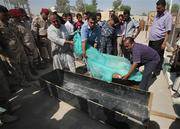
In Karbala, dozens of mourners gathered near the city morgue Tuesday to receive the bodies of their relatives. Many wailed in grief and beat their heads as the bodies were lain in the morgue yard.
"Where is the government? Where are the security forces?" cried one woman who said her son was among those killed.
Violence has dropped dramatically across Iraq, but deadly shootings and bombings still happen nearly every day.
Monday's attack took place fewer than four months before U.S. troops - who surged into Iraq in 2007 to stem the sectarian killings - are scheduled to leave the country.
In Anbar province in particular, many insurgents have launched attacks while posing as soldiers or other security guards.
Sheik Ahmed Abu Risha, leader of the province's Awakening Council, the Sunni security militia that turned against al-Qaida, announced a 50 million dinar reward (about $42,000) for any person who gives information that leads to the arrest of the people behind the bus attack.
