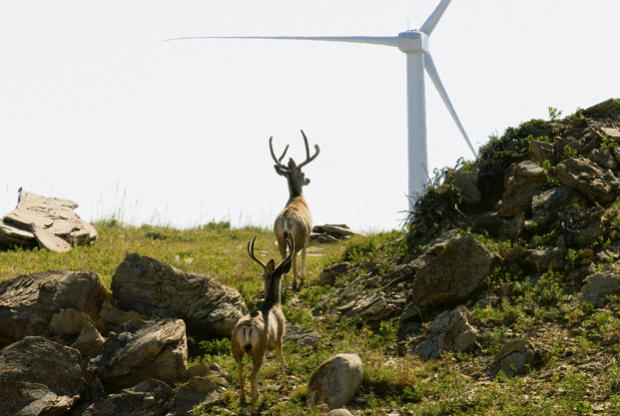
 The 99MW Campbell Hill is one of four
Duke Energy wind farms in Wyoming
Photograph: Duke Energy
The 99MW Campbell Hill is one of four
Duke Energy wind farms in Wyoming
Photograph: Duke Energy
High in the deer-and-antelope country of central Wyoming, Duke Energy’s 11-month-old flagship 200MW Top of the World wind farm is a sight to behold.
Framed against an intense blue sky on a mild summer day, 66 GE and 44 Siemens turbines effortlessly generate power, driven by strong, steady winds that whistle across the high plains.
Wind supporters say the scene, complete with a farmhouse and grazing horses, is a powerful symbol of how the emerging industry is helping to sustain traditional ranching and promote economic growth.
They envisage Wyoming in this decade and beyond becoming a major exporter of wind energy to California, the largest power-hungry market in the West, and possibly to Eastern states and north to Alberta, Canada.
Wyoming is perhaps the least-known frontier of US wind development.
With 1.4GW of installed capacity, it has barely tapped its estimated 552GW of potential. Although not all of that resource can be developed, what remains is among the best onshore wind in the country, according to the National Renewable Energy Laboratory.
This should give the Equality State a competitive advantage despite its distance from big energy markets, by enabling turbines to achieve a higher capacity factor and produce more wind power at lower cost, says Rob Hurless, an energy adviser to Governor Matt Mead.
Wyoming’s quandary is where wind fits into its mix of energy, which already accounts for a big chunk of the $38.5bn state economy. Fossil fuels generate so much revenue that when it is combined with prudent fiscal policies, Wyoming’s finances are among the most rock-solid in the country.
The oil and gas industry has its headquarters down the road in Casper. Not far to the north is the Powder River Basin, which contains one of the world’s largest deposits of coal — all of it low-sulphur. Wyoming has been the nation’s top coal producer since 1988. It also obtains lots of natural gas through coal-bed methane extraction.
Mead dismisses as short-sighted the argument that wind energy should not co-exist with carbon fuels. But he opposes a renewable portfolio standard to promote wind, saying that it would squelch the free market for coal, gas and oil.
“Let’s add to what we have in our energy portfolio, rather than saying, ‘We want this or we’re going to remove that’,” the governor says.
For all its potential, wind growth will depend on multiple factors that Wyoming can only partly control. At the federal level, there is uncertainty over whether Congress will extend the production tax credit for wind beyond 2012.
Letting it expire would change the economics of wind projects, making them harder to carry out, says Jeff Hymas, a spokesman for Rocky Mountain Power, the regulated utility that owns nine wind farms in Wyoming totalling 626.6MW.
There appears little chance that Congress will continue funding the popular Section 1603 cash grant and Department of Energy loan-guarantee programmes that are set to expire this year.
Mead agrees that the wind industry would be hurt if some or all of those incentives were to disappear, but says such a move must be considered within a context of soaring federal debt and deficits. He is confident that Wyoming will remain a good place for wind energy “as long as we’re on equal footing with other states”.
What happens in Washington DC is of more than a passing interest for Wyoming. The federal government owns about half of the state’s land, which is held in trust for the American people and is managed by agencies within the agriculture and interior departments.
These properties include monuments, national parks, historic sites, recreation areas and wildlife refuges. Much of it is land that was not claimed for settlement during the country’s westward expansion in the 19th century. The US government also owns mineral rights on large swathes of private land.
Relations have been stormy at times.
Wyoming has wanted a faster federal timetable for issuing leases to provide regulatory certainty and to obtain millions of dollars in revenue that the two governments share from bids and royalties.
There is also frustration over the slow pace of approvals for badly needed transmission to be built on federal land that would allow larger-scale wind development.
Interior Secretary Ken Salazar, a former US senator and rancher from neighbouring Colorado, has been a breath of fresh air for Mead in his dealings with the Obama administration.
“I don’t have to explain to him what the West is like,” Mead says. “I can’t tell you how important that is because people don’t understand if they have never been out here. He and I don’t agree on everything, but at least we don’t have to have an education session every time we meet.”
Salazar’s Bureau of Land Management, which oversees one fifth of Wyoming territory, is reviewing eight wind farm proposals. One of the three most advanced with development plans is the 2-3GW, 1,000-turbine Chokecherry and Sierra Madre project. If it is approved, the agency would enter into a lease arrangement with the developer.
Another agency that Salazar manages has endorsed the controversial strategy for protecting the sage grouse imposed by Mead’s predecessor in 2008, which excludes wind development in some regions, to the anger of landowners.
Published: Friday, September 16 2011