EIA projects world energy use to increase 53 percent by 2035; China
and India account for half of the total growth
International Energy Outlook 2011 (IEO2011) released today
by the U.S. Energy Information Administration (EIA) presents updated
projections for world energy markets through 2035. The IEO2011
Reference case projection does not incorporate prospective legislation
or policies that might affect energy markets.
Worldwide energy consumption grows by 53 percent between 2008 and
2035 in the Reference case, with much of the increase driven by strong
economic growth in the developing nations especially China and India.
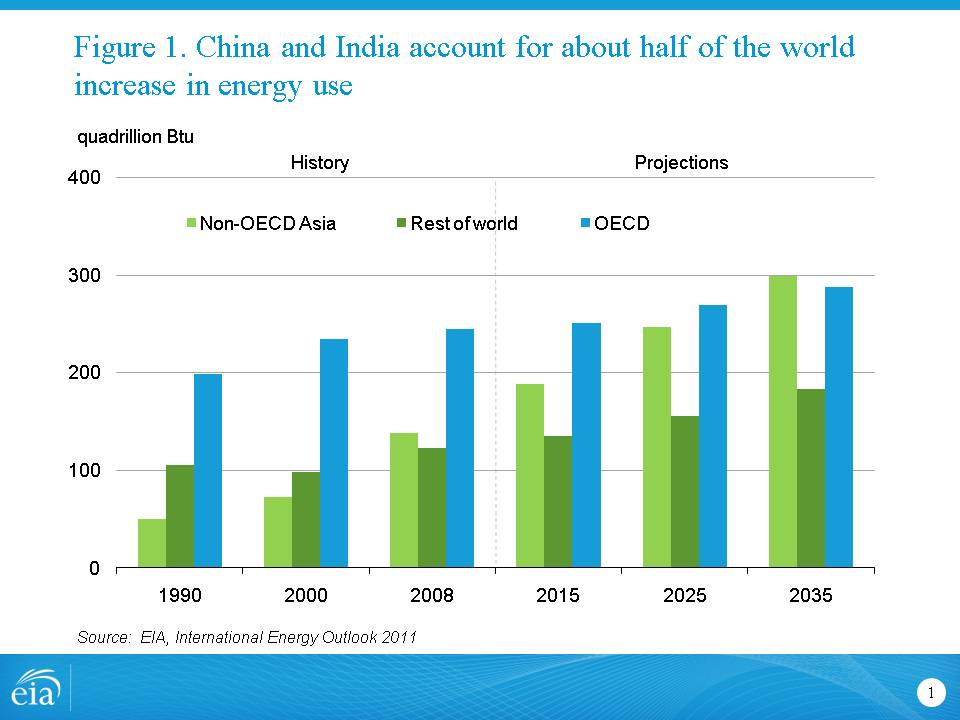
"China and India account for half of the projected increase in world
energy use over the next 25 years. China alone, which only recently
became the world's top energy consumer, is projected to use 68 percent
more energy than the United States by 2035." said Acting EIA
Administrator Howard Gruenspecht.
Some key findings:
- China and India lead the growth in world demand for
energy in the future. The economies of China and India were
among those least affected by the worldwide recession. They continue
to lead world economic growth and energy demand growth in the
Reference case. In 2008, China and India combined accounted for 21
percent of total world energy consumption. With strong economic
growth in both countries over the projection period, their combined
energy use more than doubles by 2035, when they account for 31
percent of world energy use in the IEO2011 Reference case (Figure
1). In 2035, China's energy demand is 68 percent higher than
U.S. energy demand.
- Renewable energy is projected to be the fastest growing
source of primary energy over the next 25 years, but fossil fuels
remain the dominant source of energy. Renewable energy
consumption increases by 2.8 percent per year and the renewable
share of total energy use increases from 10 percent in 2008 to 15
percent in 2035 in the Reference case. Fossil fuels, however,
continue to supply much of the energy used worldwide throughout the
projection, and still account for 78 percent of world energy use in
2035 While the Reference case projections reflect current laws and
policies as of the start of 2011, past experience suggests that
renewable energy deployment is often significantly affected by
policy changes.
- Natural gas has the fastest growth rate among the fossil
fuels over the 2008 to 2035 projection period. World
natural gas consumption increases 1.6 percent per year, from 111
trillion cubic feet in 2008 to 169 trillion cubic feet in 2035.
Unconventional natural gas (tight gas, shale gas, and coalbed
methane) supplies increase substantially in the IEO2011
Reference case—especially from the United States, but also from
Canada and China.
- World oil prices remain high in the IEO2011
Reference case, but oil consumption continues to grow; both
conventional and unconventional liquid supplies are used to meet
rising demand. In the IEO2011 Reference case the
price of light sweet crude oil (in real 2009 dollars) remains high,
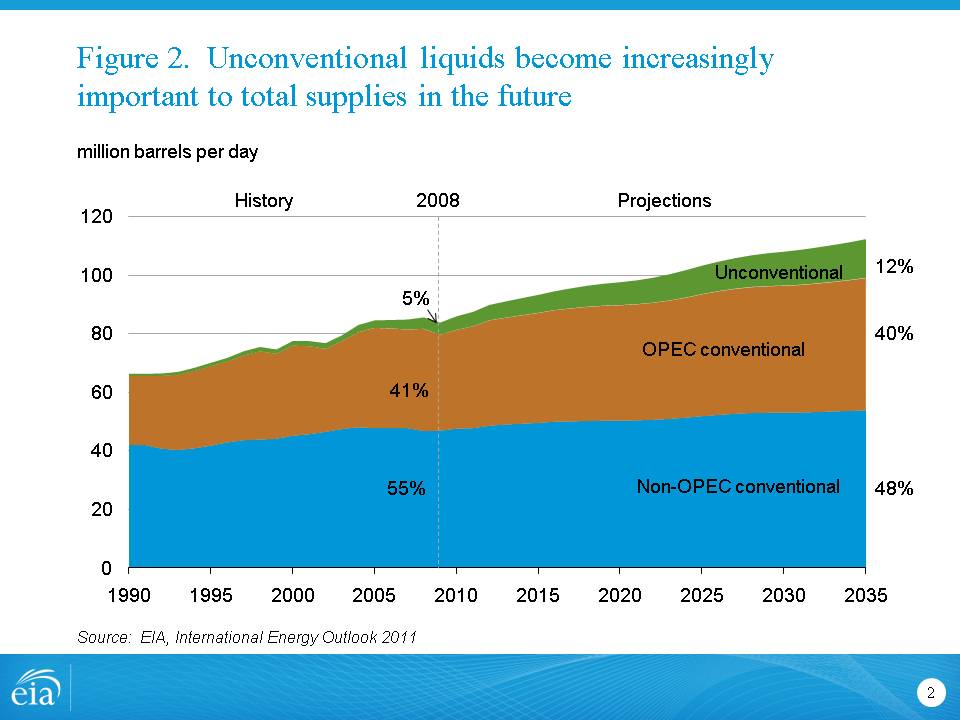
reaching $125 per barrel in 2035. Total world petroleum and other
liquids fuel use increases by 26.9 million barrels per day between
2008 and 2035, but the growth in conventional crude oil production
is less than half this amount at 11.5 million barrels per day, while
production of natural gas plant liquids increase by 5.1 million
barrels per day, World production of unconventional resources
(including biofuels, oil sands, extra-heavy oil, coal-to-liquids,
and gas-to-liquids), which totaled 3.9 million barrels per day in
2008, increases to 13.1 million barrels per day in 2035 (Figure
2).
Other report highlights include:
- From 2008 to 2035, total world energy consumption rises by an
average annual 1.6 percent in the IEO2011 Reference case.
Strong economic growth among the non-OECD (Organization for Economic
Cooperation and Development) nations drives the increase. Non-OECD
energy use increases by 2.3 percent per year; in the OECD countries
energy use grows by only 0.6 percent per year.
- Petroleum and other liquid fuels remain the largest energy
source worldwide through 2035, though projected higher oil prices
erode their share of total energy use from 34 percent in 2008 to 29
percent in 2035.
- Projected petroleum consumption and prices are very sensitive to
both supply and demand conditions. Higher economic growth in
developing countries coupled with reduced supply from key exporting
countries result in a High Oil Price case in which real oil prices
exceed $169 per barrel by 2020 and approach $200 per barrel by 2035.
Conversely, lower economic growth in developing countries coupled
with increased supplies from key exporting countries result in a Low
Oil Price case in which real oil prices fall to about $55 per barrel
in 2015 and then gradually decline to $50 per barrel after 2030
where they remain through 2035.
- World coal consumption increases from 139 quadrillion Btu in
2008 to 209 quadrillion Btu in 2035, at an average annual rate of
1.5 percent in the IEO2011 Reference case. In the absence
of policies or legislation that would limit the growth of coal use,
China and, to a lesser extent, India and the other nations of
non-OECD Asia consume coal in place of more expensive fuels. China
alone accounts for 76 percent of the projected net increase in world
coal use, and India and the rest of non-OECD Asia account for
another 19 percent of the increase.
- Electricity is the world's fastest-growing form of end-use
energy consumption in the Reference case, as it has been for the
past several decades. Net electricity generation worldwide rises by
2.3 percent per year on average from 2008 to 2035. Renewables are
the fastest growing source of new electricity generation, increasing
by 3.0 percent and outpacing the average annual increases for
natural gas (2.6 percent), nuclear power (2.4 percent), and coal
(1.9 percent).
- The transportation sector accounted for 27 percent of total
world delivered energy consumption in 2008, and transportation
energy use increases by 1.4 percent per year from 2008 to 2035. The
transportation share of world total liquids consumption increases
from 54 percent in 2008 to 60 percent in 2035 in the IEO2011
Reference case, accounting for 82 percent of the total increase in
world liquids consumption
- In the IEO2011 Reference case, energy-related carbon
dioxide emissions rise from 30.2 billion metric tons in 2008 to 43.2
billion metric tons in 2035—an increase of 43 percent. Much of the
increase in carbon dioxide emissions is projected to occur among the
developing nations of the world, especially in Asia.
International Energy Outlook 2011 is available at:
http://www.eia.gov/forecasts/ieo/.
The product described in this press release was prepared by
the U.S. Energy Information Administration (EIA), the statistical
and analytical agency within the U.S. Department of Energy. By law,
EIA's data, analysis, and forecasts are independent of approval by
any other officer or employee of the United States Government. The
views in the product and press release therefore should not be
construed as representing those of the Department of Energy or other
Federal agencies.
EIA Program Contact: John Conti, 202-586-2222,
john.conti@eia.gov
EIA Press Contact: Jonathan Cogan, 202-586-8719,
jonathan.cogan@eia.gov
EIA-2011-12
|