Focus Fusion could power civilization cheaply and cleanly
Lawrenceville Plasma Physics LLC has announced that they have indisputable evidence that they have achieved 1 billion degrees via plasma confinement. With another year of experimentation followed by three years of development, they could be ready to bring to market a 5 MW plant (size of the largest wind turbines) that only costs $300,000.
by
Sterling D. Allan
Pure Energy Systems News
|
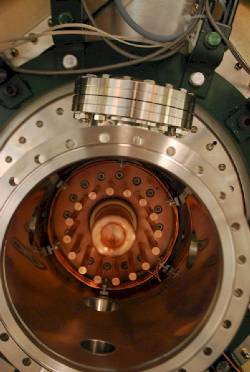
A view of the central electrodes (middle), just four inches across, where the LPP team has now confirmed strong confinement in addition to high energies. |
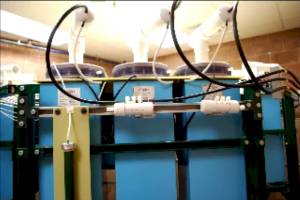 LPP's Dense Plasma Fusion in its experimental chamber. |
|
|

MIDDLESEX, NEW JERSEY, USA --
Focus
Fusion by Lawrenceville Plasma Physics LLC (LPP) was the first
technology to make it into the Top 100 Clean Energy Technologies listing
back in November 2005 when we first launched the New Energy Congress for
reviewing and prioritizing breakthrough clean energy technologies.
The promise of their technology is amazing, and now they've achieved yet
another milestone, proving billion degree plasma confinement – a feat
that will be published in the Journal of Fusion Energy.
Focus fusion technology entails hydrogen and boron combining into
helium, while giving off tremendous amounts of energy in the process,
without any radioactive waste.
According to the
interview
I did with inventor Eric Lerner back in 2005, which was featured at
Slashdot, this technology could give birth to a non-polluting power
plant the size of a local gas station that would quietly and safely
power 4,000 homes, for a few tenths of a penny per kilowatt-hour,
compared to 4-6 cents/kw-h of coal or natural-gas-powered plants. One
technician could operate two dozen of these stations remotely. The fuel,
widely available, is barely spent in the clean fusion method, and would
only need to be changed annually.
The size and power output would make it ideal for providing localized
power, reducing transmission losses and large-grid vulnerabilities. The
cost and reliability would make it affordable for developing nations and
regions.
New Energy Congress founding advisor, and US patent office reviewer,
Dr. Thomas
Valone, of Integrity Research Institute calls it "the most ideal
fusion project," and he even points to it as the most feasible, but
neglected, energy technology in general.
Lerner was a guest speaker at Google Tech talks in October of 2007. (Ref.)
Last week they
announced in a press release (excerpt):
In a breakthrough in the effort to achieve controlled fusion energy, a research team at Lawrenceville Plasma Physics, Inc. announced that they have demonstrated the confinement of ions with energies in excess of 100 keV (the equivalent of a temperature of over 1 billion degrees C) in a dense plasma. They achieved this using a compact fusion device called a dense plasma focus (DPF), which fits into a small room and confines the plasma with powerful magnetic fields produced by the currents in the plasma itself. Reaching energies over 100 keV is important in achieving a long-sought goal of fusion research—to burn hydrogen-boron fuel. Hydrogen-boron, (also known by its technical abbreviation, pB11) is considered the ideal fusion fuel, since it produces energy in the form of charged particles that can be directly converted to electricity. This could dramatically cut the cost of electricity generation and eliminate all production of radioactive waste.
I phoned Lerner to ask about his development,
since they had announced billion-degree temperatures previously.
He said that critics had said that the previous set-up could not rule
out the possibility that this temperature was merely a function of the
beam they were creating. The new results show definitively that
"confinement" is indeed happening, and is the source of the temperature,
which is a key attribute needed to develop a practical commercial
reactor.
Yesterday, LPP
announced:
The focus fusion effort received good news from the academic world today with the acceptance of an article by LPP's science team by the peer-reviewed Journal of Fusion Energy. The article, titled "Theory and experimental program for p-B11 Fusion with the Dense Plasma Focus," was authored by LPP lead scientist Eric J. Lerner and LPP senior scientists Dr. S. Krupakar Murali and Dr. Abdelmoula Haboub. The article is particularly significant as the first peer-reviewed publication of the basic theory guiding LPP's pursuit of useful fusion energy from the dense plasma focus, as well as featuring the first experimental results from the team's Focus Fusion-1 experimental device in Middlesex, NJ.
Lerner told me that the experimental phase is
taking longer than they had projected. The anticipated two years
will be more like three, and is expected to be completed at the end of
2011. He then anticipates that the development phase will take
another three years, assuming adequate funding.
Once in the marketplace, he expects that a 5 megawatt plant using this
technology would cost around $300,000 once mass produced. That's
$0.3 per installed watt of clean, non-polluting, energy from a clean,
cheap, virtually inexhaustible fuel source.
Here are a couple of videos that illustrate the Dense Plasma Focus
process.
|
What is the dense plasma focus, and how does it work to achieve nuclear fusion? Could it be used to achieve net energy? (YouTube / FocusFusionSociety; November 12, 2009) |
|
|
|
Animation of how Dense Plasma Focus Clean small scale Nuclear Fusion Energy works. (YouTube / FocusFusionSociety; October 19, 2009) |
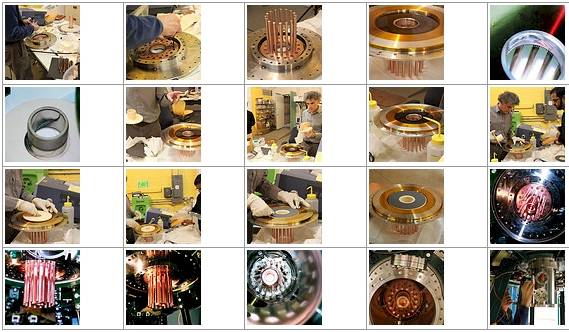
Their site has a page featuring various photos of the device.
The following is taken from a story we published in 2005:
|
Focus fusion is not "fission." As stated on the focus fusion
website: "A fission reactor is the type of nuclear reactor we are all
used to, and these use chain reactions which can lead to meltdown. They
also have problems with radioactive waste." Focus fusion has no
such problems.
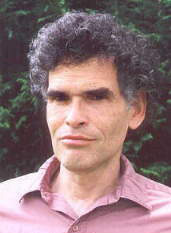
Lerner has been pulling together the theoretical basis for this
technology for two decades. Since 1994 he has been able to secure
funding, beginning with a grant from NASA's Jet Propulsion Laboratory.
That initial grant enabled him to test key components of his theory.
Though that funding has dried up apparently due to cuts in NASA's
propulsion research, Lerner has been able to land ongoing funding to
keep the research advancing.
It is no wonder that NASA would be interested, inasmuch as the modeling
predicts that a craft using Lerner's technology could reach Mars in just
two weeks. The ionic particles would be escaping out the rocket
nozzle at 10,000 kilometer per second, compared to the 2 km/s of present
rocket propellant.
Efficiency and Safety
In the case of electricity generation, the speeding ionic particles
would be coupled directly to the generation of electricity through a
beam of ions being coupled by a high tech transformer into currents that
are fed to capacitors, which would both pulse the energy back through
the device to keep the process going, as well as send excess energy out
for use on the grid.
This direct coupling is one of the primary advantages of this
technology. It sidesteps the centuries-old approach of converting water
to steam in order to drive turbines and generators. That process
accounts for 80% of the total capital costs required in a typical power
plant. By going straight from the fusion energy to electricity, Lerner's
fusion process eliminates that need altogether, enabling streamlining of
the process and a much smaller size to achieve equivalent power output.
And his device could be fired up and shut off with the flip of a switch,
with no damaging radiation, no threat of meltdown, and no possibility of
explosions. It is an all-or-nothing, full-bore or shut-off scenario.
Because it can be shut off and turned on so easily, a bank of these
could easily accommodate whatever surges and ebbs are faced by the grid
on a given day, without wasting unused energy from non-peak times into
the environment, which is the case with much of the grid’s energy at
present. (Ref.)
How the Theoretical Focus Fusion Reactor Works
The proposed focus-fusion reactor involves two components: the
hydrogen-boron fuel, and a plasma focus device. The combination of these
into the focus-fusion process is the invention of Eric Lerner.
The plasma-focus technology has been well established elsewhere, and has
a forty-year track record. Invented in 1964, the Dense Plasma Focus
(DPF) device is used in many types of research. (Ref.)
As described on the Focus Fusion website, the DPF device consists of two
cylindrical copper or
beryllium electrodes nested inside each other. The outer electrode
is generally no more than six to seven inches in diameter and a foot
long. The electrodes are enclosed in a vacuum chamber with a
low-pressure gas (the
fuel for the reaction) filling the space between them. [Update:
their outer electrodes are only 4 inches in diameter, as shown in the
photos above.]
.
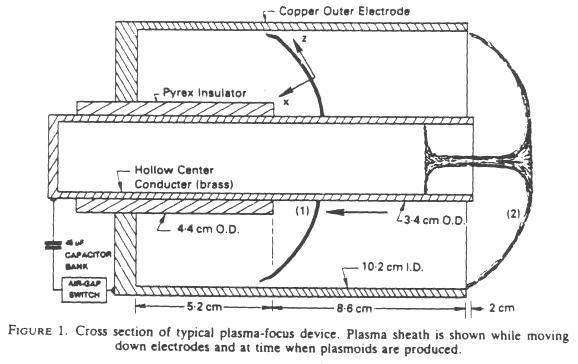
The Dense Plasma Focus
device is roughly the size of a coffee can.
Next comes the fuel. The gas Lerner plans to use in the DPF is
a mixture of Hydrogen and Boron. Their site gives an explanation
of the research steps needed to use this type of fuel with the DPF. (Ref1;
Ref2.)
According to their site, the way the proposed focus fusion reactor would
work is as follows:
A pulse of electricity from a capacitor bank is discharged across the electrodes. For a few millionths of a second, an intense current flows from the outer to the inner electrode through the gas. This current starts to heat the gas and creates an intense magnetic field.
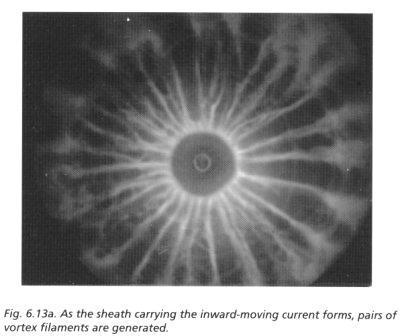
Guided by its own magnetic field, the current forms itself into a thin sheath of tiny filaments -- little whirlwinds of hot, electrically-conducting gas called plasma.
|
Picture of plasma filaments: |
 |
|
| Schematic drawing of plasma filaments: |
|
|
|
| Photo of hot plasma vortex filaments |
 Hot
plasma vortex filaments pinched together by their own
magnetic fields in a plasma focus fusion device. Hot
plasma vortex filaments pinched together by their own
magnetic fields in a plasma focus fusion device.Photo taken by Winston Bostick & Victorio Nardi using an exposure time of a few nanoseconds. (Ref) |
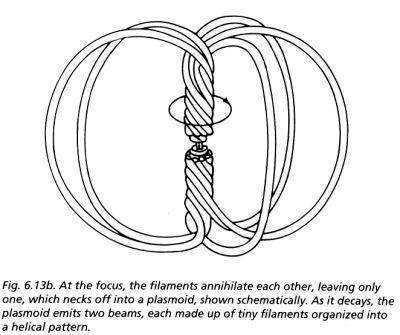
This sheath travels to the end of the inner electrode where the magnetic fields produced by the currents pinch and twist the plasma into a tiny, dense ball only a few thousandths of an inch across called a plasmoid. All of this happens without being guided by external magnets.
The magnetic fields very quickly collapse, and these changing magnetic fields induce an electric field which causes a beam of electrons to flow in one direction and a beam of ions (atoms that have lost electrons) in the other. The electron beam heats the plasmoid, thus igniting fusion reactions which add more energy to the plasmoid. So in the end, the ion and electron beams contain more energy than was input by the original electric current.
These beams of charged particles are directed into decelerators which act like particle accelerators in reverse. Instead of using electricity to accelerate charged particles they decelerate charged particles and to produce electricity. (Ref. The above quote was slightly edited.)
Some of this electricity is recycled to power the next fusion pulse,
at a frequency expected to be optimal at around 1000 times per second.
The excess energy from each pulse is available as net energy, and is
output as product electricity from the fusion power plant for
sale to the grid – or will be, once this is all proven and implemented.
X-Ray Shielding
While the process would not create residual radioactivity, it does give
off strong x-ray emissions, which can be harnessed by a high-tech
photoelectric cell for additional energy capture in a process similar to
a photovoltaic solar cell. The primary difference is in the
concentration of particles. "Solar energy is diffuse," said
Lerner, explaining that the focus fusion process would be highly
concentrated: 10,000 kilowatts per square meter, compared to
1 kw / m2 with solar. So the cost-to-yield ratio would
be extremely favorable in the case of the x-ray energy capture.
There will also need to be shielding from the pulsing electromagnetic
fields generated by the reactor.
In addition to x-rays, the process would also yield "low energy
neutrons", Lerner said. These would not produce long-lived
radioactivity, but at most would only produce "extremely short-lived
elements with very short half-lives. Only 1/500th of the
total energy would be carried by the neutrons."
"You could walk into the facility a second after turning it off, and
would not be able to detect any radiation above background," he said.
The materials of which the reactor and facility are constructed would
not build up any radioactivity either, even over time.
For safety, Lerner said that a layer of lead and a layer of boron
shielding surrounding the reactor would be adequate protection for the
focus fusion plant.
As for possible accidents with the reactor, there is "not really
anything that could go wrong," and, because of the way the reaction
stops immediately, "there is [no possibility] for runaway." Lerner
affirms, "It's 100% safe."
Some heat is vented into the environment, but it is not to such an
extent that a generating plant could not be situated in a neighborhood,
such as where substations presently are located.
About the worst thing that could happen would be a capacitor failure,
but that would not even damage the building, he said.
Of course there are always the risks of electrocution, and shorting-out
hazards associated with electricity, but those would be present in any
power-plant situation.
Remember, with this technology, on-site personnel are not needed on a
daily basis, reducing the exposure of persons to such hazards.
Maintenance would be rare. One technician could operate a dozen
facilities by him or herself.
Politics and Present Status
Imagine! At the flip of a switch, going from room temperature
(or from the temperature of boiling water in the case of the liquid
decaborane fuel), all the way up to a billion degrees, and then up to 6
billion degrees, all in a fraction of a second; then with another flip
of the switch, when you are done, going back down to ambient
temperature. And in the interim, you have produced excess energy
from fusion -- safely, cleanly.
Part of that theoretical equation has been proven. Part has yet to
be proven. [Update: now proven.]
Lerner credits the field of astrophysics as playing a significant role
in serendipitously developing much of the theoretical basis behind focus
fusion, due to the parallels between neutron star research and plasma
physics.
Mary-Sue Haliburton, chief editor for PESN, points out that the
plasma filaments in the plasma focus are a microcosmic version of the
Birkeland currents visible in the sun's corona, as well as in
interstellar and even intergalactic space. (Ref
- site shows photo of Birkeland current in sun's corona.)
Based on his focus-fusion research done through the grant from JPL at
the University of Illinois, his subsequent research at Texas A&M
University, and research done at the Los Alamos National Laboratory
(LANL), Lerner et al. have proven the ability to attain, and even to
surpass, the billion degree benchmark. (Ref)
Coming to a Car Near You?
Lerner said that the applications of this technology will be limited
on the smaller end to local power-plant-sized operations for the near
future, and that putting one of these in your garage or in your car will
be years yet into the future. Miniaturization is a long-term dream that
is sure to be achieved as the technology takes hold, just as it has in
other industries such as computers and batteries.
# # #
What You Can Do
- Pass this on to your friends and favorite news sources.
- We at PES Network are in a real pinch right now. Donations would be greatly appreciated.
- Subscribe to our newsletter to stay abreast of the latest, greatest developments in the free energy sector.
- Let professionals in the renewable energy sector know about the promise of Focus Fusion
- Consider investing in LPP
SOURCES
- LPP Announces Breakthrough Billion Degree Confinement - press release
- Journal of Fusion Energy accepts LPP article for publication - press release
- Telephone interview with Eric Learner by Sterling D. Allan (January 12, 2011)
- http://www.focusfusion.org - company website (non-profit, educational)
- http://www.lawrencevilleplasmaphysics.com/ - Company corporate website
- http://integrityresearchinstitute.org - Tom Valone's Integrity Research Institute website.
CONTACTS:
Lawrenceville Plasma Physics Inc.
40 Ridge Drive
Berkeley Heights, NJ 07922
Phone: (732) 356-5900
Fax: (732) 377 0381
For email,
lpp@lawrencevilleplasmaphysics.com